Rental Yield & ROI Calculator for Nigeria (Gross, Net & Cash-on-Cash)
Enter a property price, monthly rent, and expenses to get gross yield, net yield, cash-on-cash ROI, and a multi-year return projection for Nigerian rental property.
Rate: $1 = ₦1,378 (fallback, as of mid-July 2026)
Typical gross yield benchmark for Lagos Mainland: 5–8%
Rental Income
One-Time Purchase Costs
Annual Expenses
Est. from Lagos Mainland default — edit or check your LIRS/state notice
Projection
Above the typical 5–8% gross yield range for Lagos Mainland.
| Year | Cumulative Net Income | Est. Future Value | Total Return | Total Return % |
|---|---|---|---|---|
| 1 | ₦7,331,538 | ₦104,500,000 | ₦16,831,538 | +15.89% |
| 3 | ₦21,994,615 | ₦126,445,000 | ₦53,439,615 | +50.45% |
| 5 | ₦36,657,692 | ₦152,998,450 | ₦94,656,142 | +89.36% |
Annualized total return over 5 years: +13.62%
For illustrative purposes only — not investment, tax, or legal advice. Land Use Charge/property tax defaults are working estimates as a share of purchase price, not the official LIRS or state assessment formula (which applies to an independently assessed market value) — check your state's Land Use Charge notice or portal for the actual figure. The 10% WHT toggle reflects the common practice of withholding tax at source on rent paid by corporate tenants under the Nigeria Tax Act 2025; individual-to-individual tenancies are shown without it by default. Cumulative net income in the projection holds rent and expenses flat at year-one levels rather than growing them year over year, which understates likely returns in an inflationary market but keeps the numbers auditable. Loan interest is shown as a simple interest-only estimate for cash-flow purposes, not a full amortization schedule. Purchase costs, expense percentages, and appreciation rates vary by state, property, and negotiation — verify with a licensed estate surveyor, lawyer, and your state's internal revenue service before making a purchase decision.
How to Actually Calculate Rental Yield and ROI on Nigerian Property
Last updated: August 2026·Reviewed by Tunde Bakare, Mortgage Analyst in Lagos·Source
Nigerian property listings almost always advertise rent-to-price ratios in a way that looks impressive — but the real question is net yield after realistic costs, and how that compares by location.
How it's calculated
Gross yield is annual rent ÷ purchase price. Net yield subtracts a full year of realistic operating costs — maintenance, agency/management fees, service charges, insurance, and Land Use Charge — before dividing by purchase price.
| Location | Typical gross yield |
|---|---|
| Lekki, Ikoyi, Victoria Island (prime Lagos) | 4% – 7% |
| Lagos Mainland | 6% – 9% |
| Abuja | 6% – 9% |
| Other Nigerian states | Often higher |
Worked example
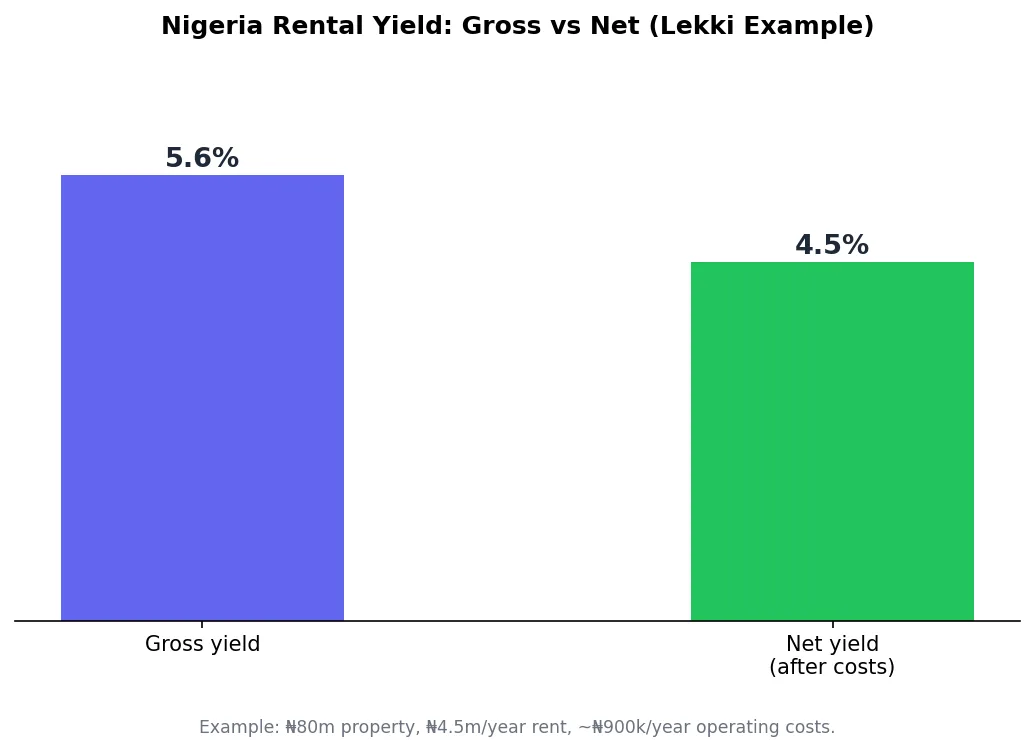
A Lekki apartment purchased for ₦80,000,000, renting for ₦4,500,000/year.
- Gross yield: ₦4,500,000 ÷ ₦80,000,000 = 5.6%
- Annual costs (maintenance, agency fee, service charge, Land Use Charge): ≈ ₦900,000
- Net income: ₦4,500,000 − ₦900,000 = ₦3,600,000
- Net yield: ₦3,600,000 ÷ ₦80,000,000 = 4.5%
The gap between gross (5.6%) and net (4.5%) is exactly why comparing only advertised gross yields across properties can be misleading.
Things to know
- Corporate tenants generally have 10% withholding tax deducted at source on rent under the Nigeria Tax Act 2025 — individual tenancies usually don't withhold this in practice.
- Land Use Charge on a rented (non-owner-occupied) property is materially higher than on an owner-occupied one under Lagos's 2018 amended law.
- Cash-on-cash ROI (net income ÷ actual cash invested, including down payment and closing costs) is a different, often more useful number than yield alone if the property is financed.
Every landlord in Lagos, Abuja, or Port Harcourt has heard the same pitch: a property "pays for itself" at a certain rent, or a new estate promises returns that sound too good to check. The trouble is that most of those numbers only ever look at gross rent against purchase price, which flatters almost any property and hides the costs that actually determine whether an investment works. A calculator that only shows gross yield is answering the wrong question. What a serious investor needs is the net picture: rent after realistic vacancy, after the expenses that come with owning property in Nigeria specifically, and after the cash that actually left their account to acquire the asset in the first place.
Gross rental yield is the easiest number to compute and the least useful on its own. It is simply annual rent divided by purchase price, expressed as a percentage. A property renting for 850,000 naira a month against a 95 million naira purchase price shows a gross yield a little above 10 percent, which looks attractive until the running costs are subtracted. Net yield corrects for that by deducting a full year of realistic operating costs from the rent before dividing by the purchase price: maintenance and repairs, typically budgeted at somewhere around 8 to 12 percent of rent; management or agency fees, another 5 to 10 percent if the landlord isn't self-managing; service charges and estate levies not already covered by the tenant; insurance; and the Land Use Charge or equivalent state property tax. A property that shows an attractive gross yield can still be a mediocre investment once those costs are subtracted, which is exactly why comparing gross and net side by side matters more than either number alone.
Location changes both the benchmark and the cost structure. Lagos carries the country's highest Land Use Charge burden, governed by the Land Use Charge Law and its 2018 amendment, which set a materially higher annual charge rate for a residential property that is rented out or not solely occupied by its owner than for owner-occupied property. In practice this means an investment property in Lekki, Ikoyi, or Victoria Island carries a heavier annual tax load than the same-value home an owner lives in personally, which is one reason prime Lagos rental yields tend to sit lower, often in the four to seven percent range, than Lagos Mainland or Abuja, where yields more commonly land in the six to nine percent band. Abuja and other states run their own tenement-rate style charges, generally lower and less standardised in how they're published, which is why this calculator treats the Land Use Charge line as an editable estimate tied to your selected location rather than a fixed figure — always check your own state's Land Use Charge notice or portal for the actual assessed amount, since it's based on an independently assessed market value rather than the purchase price used here.
Withholding tax is another line that trips people up because it depends on who the tenant is, not where the property sits. Under the Nigeria Tax Act 2025, a 10 percent withholding tax is commonly deducted at source on rent paid by corporate tenants, meaning a company leasing office or residential space for its staff typically withholds that percentage before paying the landlord, who then reconciles it against their tax liability. Individual-to-individual tenancies, the far more common arrangement for a single rental unit, generally don't have this withheld in the same way in practice, which is why this tool makes it a toggle tied to tenant type rather than applying it automatically to every calculation.
Return on investment goes a step further than yield by accounting for how the purchase was financed and what it actually cost to acquire the property, not just its sticker price. Buying property in Nigeria carries a bundle of one-time costs on top of the purchase price: legal fees typically running 5 to 10 percent of the property value, a similar range for buyer-side agency commission, and stamp duty commonly quoted around 1.5 percent of the transaction value, on top of separate perfection and registration costs. Add renovation or furnishing spend and a down payment if financing is involved, and the true cash invested is usually well above the headline purchase price. Cash-on-cash return divides net annual income, after any loan interest, by that total cash invested, which is why two properties with an identical net yield can show very different ROI once one is bought with a mortgage and the other with cash.
Projecting returns over several years adds a final, honest layer: expected capital appreciation compounded against the purchase price, combined with several years of net rental income, measured against the cash actually invested. Nigerian property appreciation varies sharply by location and market cycle, which is why the projection here uses an editable annual rate rather than a single fixed assumption, and why cumulative income is held flat at year-one levels rather than assumed to grow, a conservative choice that keeps the numbers auditable rather than optimistic. None of this replaces professional advice from a licensed estate surveyor, a property lawyer, or your state's internal revenue service before committing real money, but it does turn a vague "good investment" pitch into a set of numbers you can actually interrogate.