Property Buyer & Seller Cost Breakdown Nigeria: Stamp Duty, Consent & Fees Calculator
Estimate total buyer and seller transaction costs for Nigerian property, including stamp duty, Governor's Consent, legal fees, agent commission and CGT.
Estimate only — not legal or tax advice
Figures use midpoint percentages from commonly reported ranges and are illustrative, not official rates. Actual charges depend on your state, the assessed government value, and individually negotiated fees. Confirm exact figures with a lawyer, your state Lands Bureau/LIRS, or FIRS before a transaction. Rates last reviewed for this tool: July 2026.
Summary
Estimated extra costs: 29.90% of property value (₦14,950,000 on ₦50,000,000).
Buyer Costs
₦5,112,500
- Stamp Duty₦1,000,000 (2.00%)
Charged on the consideration or assessed value, whichever is higher; paid before consent is granted.
- Governor's Consent & Related Fees₦1,500,000 (3.00%)
Bundles consent fee with typical admin/neighbourhood charges. The single biggest variable — differs by state and by assessed value.
- Registration Fee₦500,000 (1.00%)
Registering the title/deed with the state land registry.
- Buyer's Legal/Conveyancing Fee₦1,612,500 (3.23%)
Includes due diligence and deed preparation, plus 7.50% VAT on the professional fee. Rate tapers down as property value rises.
- Survey / Valuation₦500,000 (1.00%)
Independent verification of boundaries/value. Typically a fixed fee rather than a percentage; varies with plot size and location.
Seller Costs
₦9,837,500
- Capital Gains Tax (CGT)₦5,000,000 (10.00%)
Estimated on the full sale value as a simplification — CGT is properly charged on the gain (sale price minus cost base), and exemptions can apply. Confirm the actual gain with a tax adviser.
- Seller's Legal Fee₦806,250 (1.61%)
Typically lighter than the buyer's side — document review rather than full due diligence, plus 7.50% VAT.
- Agent Commission₦4,031,250 (8.06%)
7.50% commission plus 7.50% VAT. Market rate commonly ranges 5–10% and is negotiable.
Approximation notice: all percentages are midpoints of commonly reported ranges (e.g. stamp duty 0.75–2%, Governor's Consent and related fees 1.5–3%, agent commission 5–10%, CGT 10% on gain). CGT here is simplified to the full sale value rather than the actual gain. Actual costs are set by state law, LIRS/FIRS practice, and negotiation, and can differ materially from these estimates.
Buyer & Seller Total Cost Breakdown for Nigerian Property Transactions
Last updated: August 2026·Reviewed by Tunde Bakare, Mortgage Analyst in Lagos·Source
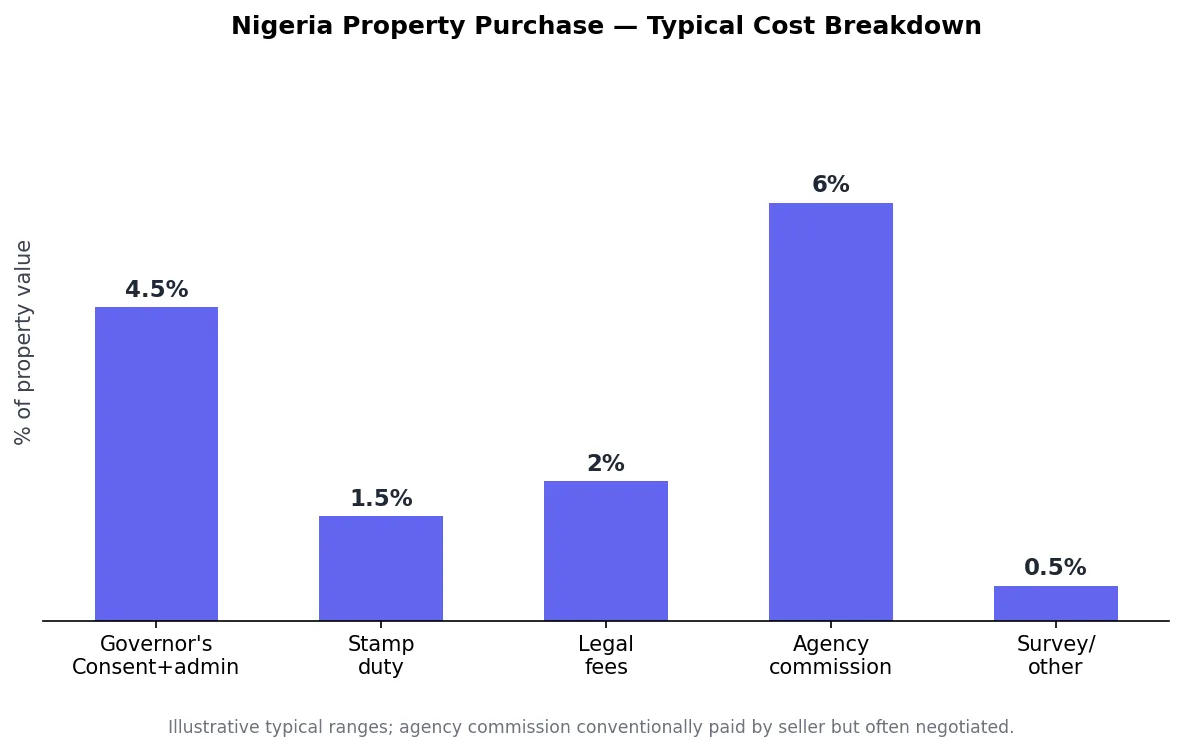
The advertised sale price is rarely what a property actually costs a buyer — stamp duty, Governor's Consent, legal fees, agency commission, and sometimes VAT all stack on top, often adding 6–12% or more to the headline figure.
How it's calculated
Most buyer-side costs are calculated as a percentage of property value, but each follows its own rules — some are flat administrative fees, some scale down as value rises, and Governor's Consent in particular varies significantly by state and by the government's own assessed value of the land.
| Cost | Typical range | Who usually pays |
|---|---|---|
| Governor's Consent + admin fees | Largest single component, varies by state | Buyer |
| Stamp duty | Percentage of value or fixed, state-dependent | Buyer |
| Legal/conveyancing fees | Scaled %, higher on lower-value deals, + 7.5% VAT | Buyer (own lawyer) |
| Agency commission | 5–10% of value + VAT | Seller (by convention, often negotiated) |
| VAT on new-build purchase | 7.5% | Buyer, only for new units from a developer |
Worked example
A buyer purchases a resale property in Lagos for ₦50,000,000.
Total buyer-side costs — Governor's Consent and admin fees, stamp duty, legal fees, and survey — commonly land in the 6–12% range, or roughly ₦3,000,000 to ₦6,000,000 on top of the ₦50,000,000 purchase price. Since it's a resale (not new-build), VAT typically doesn't apply to the property itself, though it does apply to the legal and agency fees.
Things to know
- Capital Gains Tax on a future sale is charged on the gain (sale price minus cost base), not the full sale price — this tool's CGT estimate is a conservative simplification since it doesn't know your specific cost base.
- Governor's Consent, required under the Land Use Act 1978, is often the single biggest and most variable line item — always confirm the current rate with the relevant state Lands Bureau.
- Legal and agency fees both attract 7.5% VAT on the fee itself, separate from any VAT on the property.
Buying or selling property in Nigeria almost always costs more than the headline price on the sale agreement. Stamp duty, Governor's Consent, registration, legal fees, survey costs, agent commission, and sometimes Capital Gains Tax all sit on top of the property value, and together they can add anywhere from roughly eight to fifteen percent or more to what a buyer actually pays, while quietly reducing what a seller actually nets. This buyer and seller cost breakdown tool exists to make that full picture visible before you commit to a transaction, using ranges drawn from the Stamp Duties Act, standard state land administration practice, and the Legal Practitioners Remuneration Order, rather than a single misleadingly precise number.
The largest and most variable buyer-side cost is usually the combination of stamp duty and Governor's Consent. Stamp duty in Nigeria is charged under the Stamp Duties Act on the instrument of transfer, typically calculated on the consideration stated in the deed or on the government's assessed value, whichever is higher, and rates commonly cited in practice run from around 0.75 percent up to 2 percent depending on the state and whether the purchaser is an individual or a company. Governor's Consent, required under the Land Use Act 1978 before a transfer of interest in land is valid, is where the real cost pressure tends to sit. Consent fees, along with the neighbourhood and administrative charges that state land bureaus typically bundle alongside them, can add another 1.5 to 3 percent of value, and this is the line item most likely to differ sharply between states and even between different offices within the same state. Lagos and Abuja, given higher land values and more layers of administrative review, tend to sit toward the higher end of these ranges.
Beyond consent, buyers typically cover registration of the title at the land registry, usually around half a percent to one percent of value, and a survey or valuation exercise to independently confirm boundaries and worth, which is more often a flat fee than a percentage, commonly falling somewhere between one hundred and fifty thousand and one million naira or more depending on the plot and location. Legal or conveyancing fees follow a scaled structure broadly consistent with the Legal Practitioners Remuneration Order, where the percentage charged tends to be higher on smaller transactions and tapers down as the property value increases, and Value Added Tax at 7.5 percent applies on top of the professional fee itself, not on the property. Where the property is a new unit purchased directly from a developer, VAT at the same 7.5 percent rate typically applies to the purchase itself, which is one of the clearest distinctions between buying new-build stock and buying a resale, where VAT generally does not apply to the land or used structure component of the sale.
On the seller's side, the two costs that matter most are agent commission and Capital Gains Tax. Agent commission in the Nigerian property market is commonly reported in the five to ten percent range, is subject to VAT on the fee itself, and while sellers conventionally bear the full commission, it is frequently negotiated and sometimes split with the buyer, particularly on higher-value transactions where both parties have leverage. Capital Gains Tax, administered under the Capital Gains Tax Act and collected by the Federal Inland Revenue Service, is charged at a flat 10 percent, but critically it applies to the gain, meaning the sale price minus the original cost base and allowable expenses, not to the full sale value. Some transactions may also qualify for exemptions, such as disposal of a seller's only or main private residence in certain circumstances. Because establishing the true gain requires the seller's original purchase records and any capital improvements made, a tool like this can only offer a simplified estimate against the full sale value as a conservative starting point, and it says so explicitly rather than presenting that simplification as the actual tax owed.
Sellers also typically retain their own lawyer, though the scope of that engagement is usually lighter than the buyer's side, often limited to reviewing the draft deed and confirming the buyer's payment terms rather than conducting full due diligence, which is reflected in a lower fee. Any outstanding Land Use Charge, ground rent, or similar state-level property charges are conventionally cleared by the seller before or at completion, since unresolved charges can hold up the consent process on the buyer's side regardless of who is technically responsible for them.
This tool lets you enter a property value once, choose whether you are looking at the transaction as a buyer, a seller, or both, select your state, and immediately see an itemized breakdown with amounts, percentages of value, and a plain-language note on each line explaining what it covers and why it varies. Adjustable inputs, including whether the property is a new build subject to VAT and how agent commission is split, let you model a few realistic scenarios rather than relying on one fixed assumption. None of this substitutes for professional advice. Nigerian property taxation and land administration practice varies by state, changes with periodic tax reforms, and depends on facts specific to your transaction, so before signing anything, buyers and sellers should confirm exact figures with a qualified lawyer, the relevant State Lands Bureau or Internal Revenue Service such as LIRS in Lagos, and, for Capital Gains Tax specifically, the Federal Inland Revenue Service. This tool is designed to help you budget realistically and negotiate from an informed position, not to replace that professional confirmation.