Nigeria Emergency Fund Calculator & Insurance Needs Estimator
Work out how many months of expenses your emergency fund needs in Nigeria, plus a rough life, health, and property insurance needs estimate.
Your Income & Profile
Monthly Essential Expenses
Use real essentials only — exclude lifestyle spending. In Nigeria, remember to include generator fuel and ongoing family obligations.
Savings Plan
Purely a projection based on the rate you enter — not a live or guaranteed rate. Keep emergency savings in an accessible, low-risk account rather than chasing yield.
Insurance Needs Estimate
If you're salaried, your employer is required to maintain Group Life cover for you of at least 3× your annual total emoluments under the Pension Reform Act — check whether that alone meets this estimate before buying a separate policy.
Educational estimate only — not financial, insurance, or tax advice, and not an insurance quote. Insurance figures are rough needs estimates based on the details you entered; get an actual quote and policy terms from a NAICOM-licensed insurer before buying cover, and note that most policies will ask for your NIN and BVN as part of onboarding. Build your emergency fund gradually — starting with one month and scaling up to your recommended target is a reasonable approach if the full amount feels out of reach today.
Nigeria Emergency Fund Calculator: How Much Should You Really Save, and What Insurance Fills the Gap
Last updated: August 2026·Reviewed by Chidinma Okafor, Tax Analyst in Lagos·Source
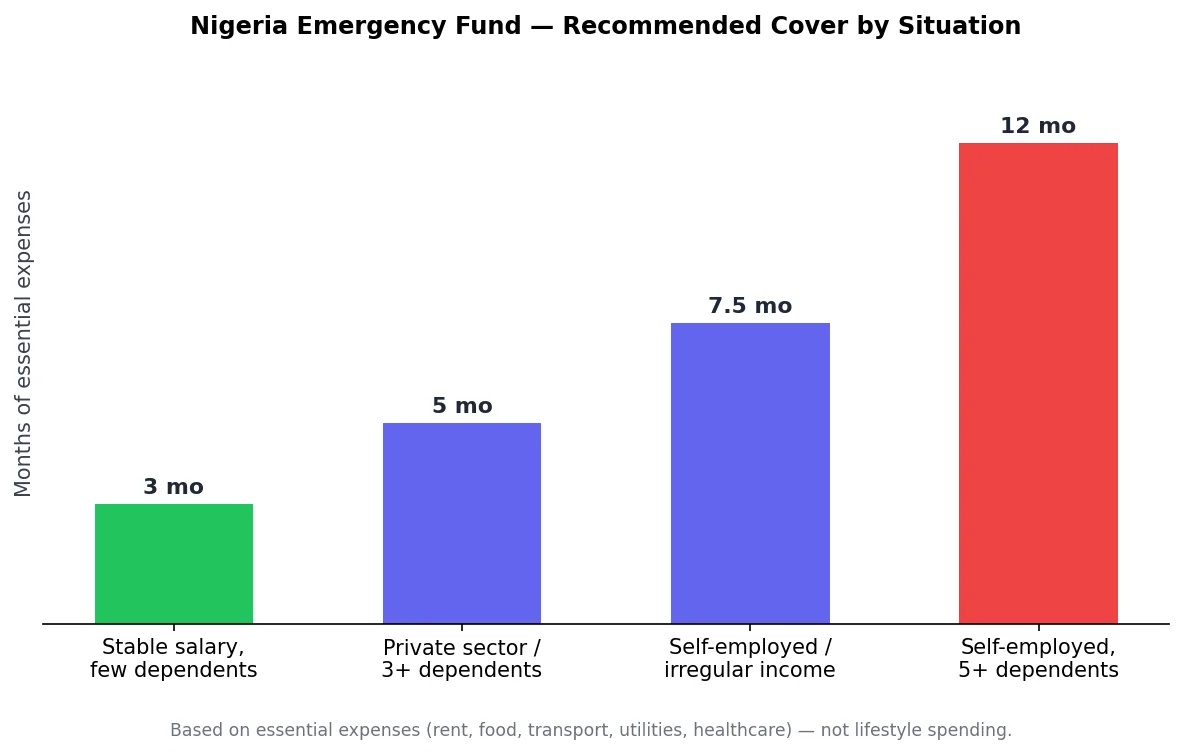
An emergency fund is sized off what you'd need to survive, not what you currently earn — and how many months of cover you need depends heavily on how stable your income actually is.
How it's calculated
Target = Essential monthly expenses × recommended months of cover, plus a 10-20% buffer for inflation and cost spikes. The months-of-cover figure scales with income stability and number of dependents.
| Situation | Recommended cover |
|---|---|
| Stable salaried income, few dependents | 3 months |
| Private-sector employee or 3+ dependents | 4–6 months |
| Self-employed / irregular income | 6–9 months |
| Self-employed with 5+ dependents | Up to 12 months |
Worked example
Tayo is self-employed with 2 dependents, and essential monthly expenses (rent, food, transport, utilities, healthcare) total ₦280,000.
- Recommended cover: 6 months (self-employed, moderate dependents)
- Base target: ₦280,000 × 6 = ₦1,680,000
- With a 15% buffer: ₦1,680,000 × 1.15 = ₦1,932,000
This is the target to hold in an easily accessible account — not invested in anything illiquid — before other savings goals take priority.
Things to know
- The fund is based on essential expenses (rent, food, transport, utilities, healthcare, school fees) — not lifestyle spending like entertainment or dining out.
- If you're salaried, check whether your employer's mandatory Group Life Insurance (minimum 3x annual emoluments under the Pension Reform Act 2014) already covers part of your life insurance need before buying additional cover.
- This tool gives a needs estimate, not an actual insurance quote — get a specific quote from a NAICOM-licensed insurer before purchasing any policy.
Most personal finance advice in Nigeria will tell you to build an emergency fund, but very few tools tell you how big that fund actually needs to be for your specific situation, or how it connects to the insurance cover you may already have through work. This Nigeria emergency fund calculator does both at once. It starts from your real monthly essential expenses, not your income, because the point of an emergency fund is to cover what you must spend to survive a job loss or a medical crisis, not to replace your entire lifestyle. From there it applies a recommended number of months based on how stable your income actually is and how many people depend on it, then layers on a separate insurance needs estimate so you can see where a lump-sum emergency fund and an insurance payout are each doing part of the job.
The starting point is your list of essential monthly expenses: rent or housing, food, transport, utilities, healthcare, school fees and family support, and any other true necessities. Nigerian households consistently underestimate the utilities line because it is really three or four costs bundled together — grid power, generator fuel, water, and mobile data — and all four tend to rise together when the naira weakens or fuel prices move. Once you total these honestly, the calculator adds an inflation and uncertainty buffer of ten to twenty percent on top, because a fund sized only for today's prices can fall short within a year in an economy where costs move quickly.
The number of months your fund should cover is not a fixed rule; it scales with how exposed you are to a sudden loss of income. Someone in a stable salaried role at a large employer with one or two dependents is reasonably covered with three months of expenses, which is the standard minimum recommendation. Someone in the private sector, or with three or more dependents, sits in a moderate range of four to six months, since either a harder job market or more mouths to feed reduces the margin for error. Someone who is self-employed, freelance, or paid on commission — where income can disappear with no notice and no severance — should be building toward six to nine months, stretching to a full year if they also support five or more dependents. The calculator applies this logic automatically based on what you select, and flags when your profile has pushed the recommendation above the standard three-month baseline so you understand why the number is higher.
Once you know the target, the tool turns it into an actual plan: enter what you already have saved and what share of your income you can set aside each month, and it estimates how many months it will take to close the gap, using a simple compound growth assumption for whatever return your savings vehicle offers. This is a projection based on the rate you type in, not a live market rate, and it is meant to keep your expectations realistic rather than to sell a particular savings product. The guidance throughout is to build gradually — a single month saved is genuinely useful, and scaling up from there beats waiting until you can fund the whole target in one go.
The insurance side works alongside the fund rather than replacing it, since a fund absorbs a short gap in income while insurance is built for the losses too large for savings to cover. The life insurance estimate scales with your annual income, your number of dependents, and your age group, reflecting that a 28-year-old with three young children needs a materially larger income-replacement multiple than a 55-year-old closer to retirement. If you are salaried, it is worth checking this estimate against what your employer is already required to provide: the Pension Reform Act obliges employers to maintain a Group Life insurance policy for staff of at least three times their annual total emoluments, so part of your need may already be met before you buy anything extra. The health estimate gives a rough sense of annual out-of-pocket exposure based on your existing healthcare spending and dependents, and the tool also flags that certain classes of property and motor insurance are compulsory under Nigerian insurance regulation administered by the National Insurance Commission, which oversees the sector under the Nigerian Insurance Industry Reform Act signed into law in August 2025, replacing the older Insurance Act framework.
None of these insurance figures are a quote, and the calculator is deliberately built not to act like one — it exists to give you a starting number to take into a conversation with a NAICOM-licensed insurer, who will ask for documentation including your NIN and BVN as part of any real policy application. Used together, the emergency fund target and the insurance estimates give you a two-layer picture of financial resilience: the fund for the short, sharp disruptions that hit within weeks, and insurance for the larger losses that a savings account alone was never designed to absorb.