Farm Loan Repayment Calculator - CBN ABP & NIRSAL Rates (Nigeria)
Free calculator to estimate repayment schedules, total interest, and periodic payments for Nigerian farm loans under CBN's Anchor Borrowers' Programme or NIRSAL-linked facilities.
ABP is typically priced at 9% per annum, all-inclusive, under CBN guidelines.
Repayment Summary
Loan Amount
₦500,000
Rate
9% p.a.
Tenure
9 months
Final Payment
₦533,750
Total Interest
₦33,750
Total Repayment
₦533,750
Principal vs Interest
At 9% p.a., this loan costs ₦33,750 in interest over 9 months.
Budget roughly ₦59,306 per month from farm income to cover this facility comfortably.
A bullet repayment structure is common for rice financing, since repayment is expected from harvest sale proceeds rather than monthly income.
Repayment Schedule
| Period | Payment | Principal | Interest | Balance |
|---|---|---|---|---|
| Final payment (month 9) | ₦533,750 | ₦500,000 | ₦33,750 | ₦0 |
Estimates only, based on a simplified flat-rate (all-in) methodology and publicly stated CBN ABP/NIRSAL rate conventions. This is not a loan offer, approval, or financial/legal advice — actual eligibility, fees, and repayment terms are set by your Participating Financial Institution (PFI), the Central Bank of Nigeria (CBN), and NIRSAL, and may differ from this estimate. Please verify current rates and terms directly with your bank before making financial decisions.
Farm Loan Repayment Calculator: Understanding ABP and NIRSAL Financing in Nigeria
Last updated: August 2026·Reviewed by Chidinma Okafor, Tax Analyst in Lagos·Source
Agricultural loans through CBN's Anchor Borrowers' Programme (ABP) or NIRSAL-guaranteed facilities come with preferential rates — but the repayment structure (often a single lump sum at harvest, not monthly installments) catches many first-time borrowers off guard.
How it's calculated
ABP loans have historically carried an all-inclusive 9% per annum rate, using simple (flat) interest rather than reducing balance — interest accrues on the full principal for the whole tenure, and for a bullet structure, principal plus all interest is due in one payment at the end, timed to harvest.
| ABP | NIRSAL-guaranteed bank loan | |
|---|---|---|
| Structure | Direct CBN intervention via anchors/PFIs | Bank loan, NIRSAL guarantees default risk |
| Typical rate | ~9% p.a., all-inclusive | Varies by bank, generally reduced due to guarantee |
| Repayment | Often bullet, at harvest | Bank-specific — can be installment or bullet |
| Typical tenure | 6–24 months (crop/livestock dependent) | Varies |
Worked example
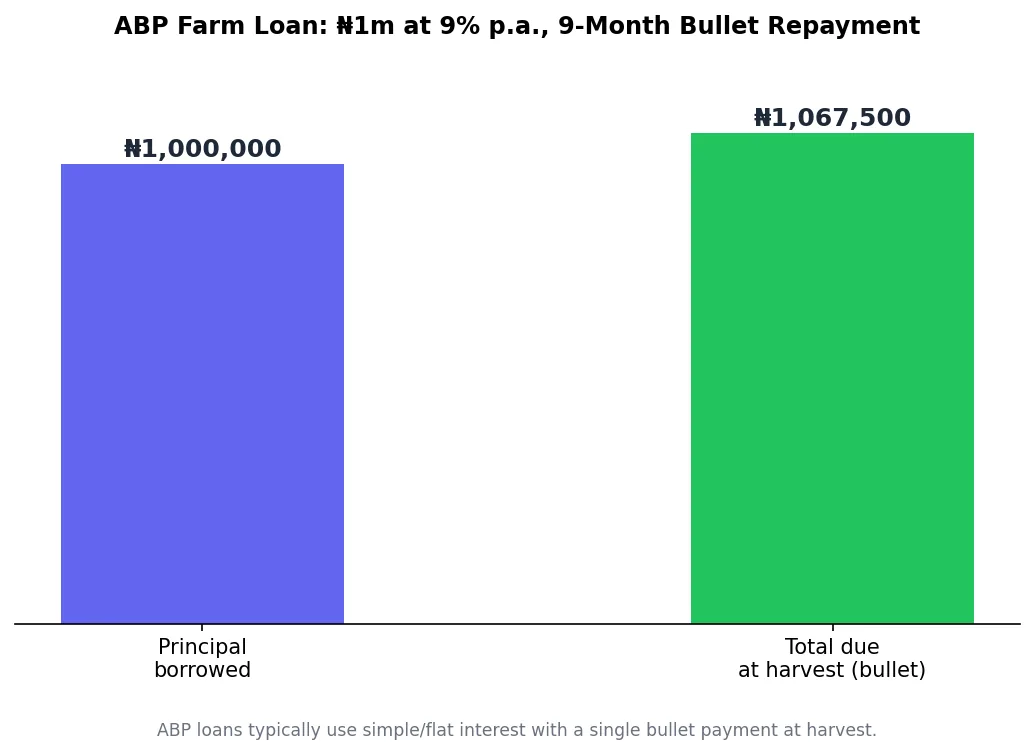
A rice farmer borrows ₦1,000,000 through ABP at 9% p.a., bullet repayment, 9-month tenure (aligned to the crop cycle).
- Interest: ₦1,000,000 × 9% × (9/12) = ₦67,500
- Total due at harvest: ₦1,067,500 — principal and interest together, in a single payment
Unlike a monthly-installment loan, there's no repayment due until the bullet date — but the farmer needs the full ₦1,067,500 available at once, which requires planning around the harvest and sale timeline.
Things to know
- This calculator uses flat/simple interest, consistent with how the ABP all-in rate is typically communicated — your actual Participating Financial Institution may apply a different method.
- Short-cycle staples like rice and maize commonly use 6–9 month tenures; livestock or tree crops may need 12–24 months or more.
- Processing fees, insurance premiums, and late-payment penalties charged by your PFI aren't included in this estimate — confirm those directly with your bank.
Nigerian farmers financing a planting season through the Central Bank of Nigeria's Anchor Borrowers' Programme, or through a NIRSAL-guaranteed facility from a Participating Financial Institution, are usually quoted a single all-in interest rate rather than a detailed amortization plan, which makes it hard to know in naira terms what a loan will actually cost by the time harvest proceeds are due. A farm loan repayment calculator built around these two schemes closes that gap by turning the loan amount, tenure, and quoted rate into a clear repayment schedule before a farmer signs any agreement with their bank.
The Anchor Borrowers' Programme was launched by the Central Bank of Nigeria in November 2015 under powers granted to the apex bank by the CBN Act 2007, with the stated goal of creating economic linkages between smallholder farmers and processors, popularly called anchors, who provide inputs on credit and offtake the resulting produce. Loans disbursed under the programme are typically priced at nine percent per annum on an all-inclusive basis, meaning the quoted rate is meant to already capture the cost of funds rather than being layered with separate processing charges, though individual Participating Financial Institutions may still apply their own administrative fees. Because ABP facilities are tied to a specific crop cycle rather than a fixed calendar term, tenures commonly run from six to nine months for short-cycle staples such as rice and maize, and up to eighteen or twenty-four months for tree crops or livestock cycles, with repayment frequently structured as a single lump sum, or bullet payment, timed to coincide with the sale of harvested produce to the anchor.
NIRSAL, the Nigeria Incentive-Based Risk Sharing System for Agricultural Lending, is a separate but related institution incorporated in 2013 as a subsidiary of the Central Bank of Nigeria. Rather than lending directly to farmers, NIRSAL provides credit guarantees and interest drawback incentives to banks that lend into agriculture, which allows Participating Financial Institutions to extend agricultural credit at reduced rates because a portion of the default risk is shared with NIRSAL. In practice, many farmers describe their financing simply as a NIRSAL loan even when the actual lender is a commercial bank or microfinance institution operating under a NIRSAL guarantee, and rates on these facilities can vary somewhat depending on the specific bank, the guarantee structure, and prevailing monetary policy conditions, which is why a calculator that allows a custom rate override is useful alongside the standard nine percent ABP default.
A farm loan repayment calculator for this market needs to reflect how these facilities are actually priced rather than assuming a conventional reducing-balance bank loan. Because the all-in rate under ABP is generally communicated as a flat figure applied across the full tenure, a flat or simple-interest calculation, where total interest equals the principal multiplied by the annual rate and by the tenure in years, tends to mirror what farmers are told more closely than a compounding reducing-balance amortization would. The calculator should let a farmer choose their programme, enter or accept a default interest rate, set a tenure aligned with their crop's growing cycle, and pick a repayment frequency that matches how they expect to receive income, whether that is a single bullet payment after harvest, a seasonal payment structure for crops with more than one cycle per year, or a more conventional quarterly or monthly schedule for mixed farming and off-farm income households.
Beyond the headline numbers, a useful farm loan repayment calculator should surface a periodic payment or lump-sum obligation, the total interest cost in naira, the total amount repayable, and a rough monthly-equivalent figure that helps a farmer sanity-check whether the facility is affordable relative to expected farm income, all while making clear that fees, insurance premiums, and penalty charges that a Participating Financial Institution may add are not included in the estimate. Optional fields for farm size in hectares and the commodity being financed, such as rice, maize, cassava, or poultry, help contextualize the numbers without pretending to replace an actual farm budget or a bank's underwriting process. A downloadable schedule that a farmer can print or share with a cooperative, an extension officer, or the anchor company can also make the tool more useful in practice, since agricultural financing decisions in Nigeria are often discussed collectively within a farmers' cooperative or outgrower scheme rather than by an individual borrower in isolation.
It is worth stressing that any farm loan repayment calculator, however carefully built, is an educational estimation tool and not a substitute for the actual loan offer a Participating Financial Institution issues, nor for direct confirmation from the Central Bank of Nigeria's Development Finance Department or from NIRSAL Plc regarding current programme terms, since guidelines, interest rates, and eligible commodities under both the Anchor Borrowers' Programme and NIRSAL-linked facilities have been revised more than once since 2015 and can change again. Farmers and agribusiness operators searching for tools related to CBN farm loan interest rates, ABP loan calculators, or NIRSAL loan repayment estimates should treat the output as a planning aid for comparing scenarios, such as a shorter six-month tenure against a longer twelve-month tenure, or a bullet repayment against a quarterly structure, rather than as a final figure to rely on when signing loan documentation. Always confirm current rates, fees, and repayment expectations directly with your Participating Financial Institution before committing to a facility.