Free Ajo & Esusu Contribution Tracker for Nigeria (Rotation Scheduler)
Track ajo and esusu contributions, rotation order, and payout dates for your Nigerian savings group — free, no sign-up, nothing leaves your browser.
Add a name for every member before moving to the Schedule tab.
Ajo & Esusu Contribution and Rotation Tracker
Last updated: August 2026·Reviewed by Chidinma Okafor, Tax Analyst in Lagos·Source
Ajo and esusu run on trust and a shared record — and the single biggest source of disputes in these groups isn't dishonesty, it's an unclear or inconsistent record of who has paid what by which cycle.
How it's calculated
Each cycle, every member contributes a fixed (or agreed variable) amount; the full pot rotates to one member per cycle until everyone has received a payout once. Tracking expected vs. actual contribution per member per cycle is what prevents disputes.
| Term | Meaning |
|---|---|
| Ajo | Yoruba term for the practice, common in South-West Nigeria |
| Esusu | Broader national term, also used in legal/academic writing |
| Cycle | One round of contribution + one payout to a rotating member |
| Pot | Total collected in a cycle (contribution × number of members) |
Worked example
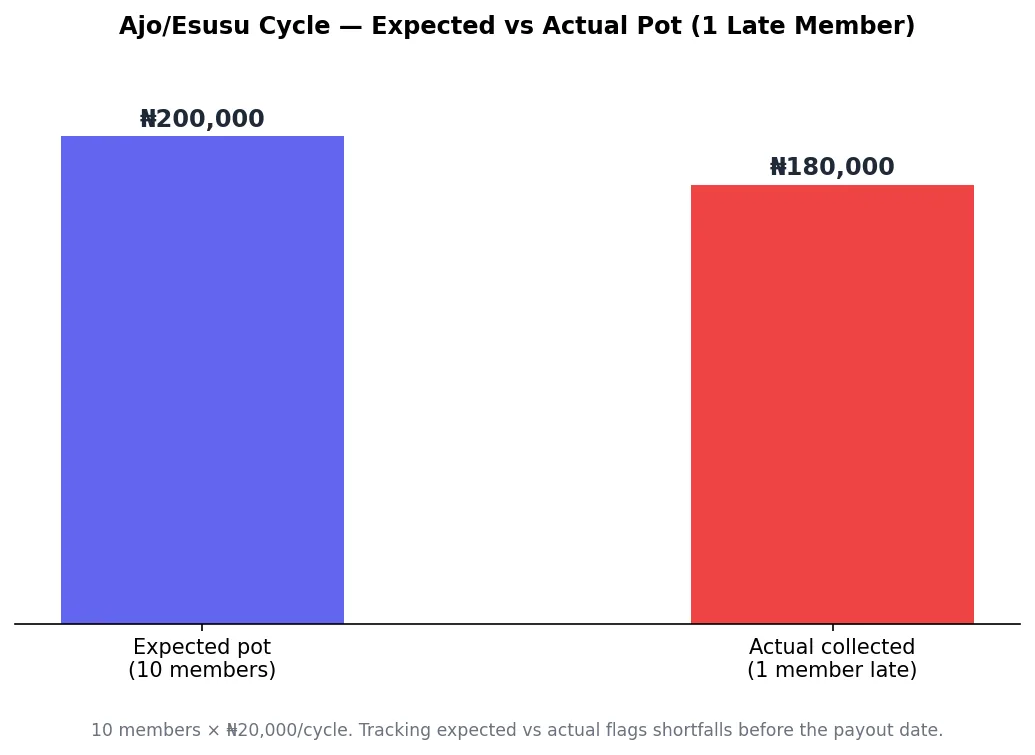
A 10-member group contributes ₦20,000 each per cycle (monthly), rotating the full pot to one member per cycle.
- Pot per cycle: 10 × ₦20,000 = ₦200,000
- Over 10 cycles (10 months), every member receives exactly one ₦200,000 payout
- If Member 4 is marked "late" in cycle 3, the tracker shows the shortfall clearly — ₦180,000 collected against ₦200,000 expected — so the group can address it before the payout date, not after
Things to know
- Informal ajo/esusu groups aren't illegal, but most are unregistered and fall outside the Nigerian Co-operative Societies Act — meaning no formal dispute-resolution structure exists unless the group registers as a cooperative.
- Mishandled funds can still be pursued under general criminal law (stealing and breach of trust provisions in the Criminal Code Act), separate from cooperative regulation.
- Agreeing in writing, before the cycle starts, what happens on a missed contribution (grace period, penalty, replacement member) prevents most disputes before they happen.
Ajo and esusu are two names for the same practice: a group of people agreeing to contribute a fixed amount of money at regular intervals, with the full pot handed to one member per round until everyone has received a payout once. Yoruba communities call it ajo, other parts of Nigeria call it esusu, and internationally the arrangement falls under the umbrella term rotating savings and credit association, or ROSCA. It is one of the oldest informal financial tools in Nigeria, used by market traders, civil servants, artisans, and salary earners who want a disciplined way to save toward a lump sum without relying on a bank loan or a formal cooperative society.
The mechanics are simple but the record-keeping is where most groups run into trouble. A typical ajo or esusu group agrees on a contribution amount, a frequency (weekly, bi-weekly, or monthly is most common), and an order in which members receive the pot. Once the order is fixed, the group cycles through it: in round one, the first member on the list collects everyone's contribution; in round two, the second member collects; and so on until every member has received a payout, at which point the group either disbands or starts a fresh cycle. Because no bank or regulator sits in the middle, the entire arrangement depends on trust, memory, and, too often, a notebook that one person keeps and everyone else has to take on faith.
That reliance on a single, informal record is exactly what an ajo esusu contribution tracker is built to fix. A digital tracker does not touch anyone's money — it never collects, holds, or transfers funds — but it gives every member of the group the same transparent view of who has paid, who is due to receive the next payout, and when the group's cycle will complete. For a market association with fifteen members contributing fifty thousand naira a month, that transparency alone prevents the two most common sources of dispute: disagreement over whether a contribution was actually made, and confusion over whose turn it is to collect.
It helps to understand the legal backdrop, because it shapes how seriously a group should take its record-keeping. Nigeria's Co-operative Societies Act sets out a formal registration path for cooperative societies, typically requiring a minimum number of members, a set of by-laws, and an application to the state's Director or Commissioner of Cooperatives before the society gains legal recognition. The overwhelming majority of ajo and esusu groups never go through this process. They remain informal, unregistered associations, which means they sit outside the regulatory oversight, dispute-resolution machinery, and legal protections that a registered cooperative enjoys. If a treasurer disappears with the pot, members cannot simply report the matter to a cooperative regulator and expect an administrative remedy the way registered members might.
That does not mean members are without recourse — it means the recourse runs through the ordinary criminal and civil courts rather than a specialised regulator. Under the Criminal Code Act, mishandling of contributed funds can fall under the general provisions on stealing in Section 390, and a treasurer who converts contributions to personal use without consent may also face breach of trust charges, both of which carry the possibility of imprisonment. In practice, prosecuting these cases is slow, and members are far better served by prevention: a clear written agreement, a rotation order everyone has seen and signed off on, and a running record of who has paid what and who has already received a payout. These are precisely the artefacts a good tracker produces automatically.
Beyond dispute prevention, a rotation and contribution tracker solves a purely practical scheduling problem. Ajo and esusu cycles run for months at a time — a twenty-member monthly group takes nearly two years to complete one full round — and manually working out that member number fourteen receives their payout in October of next year is tedious and error-prone, especially once a member drops out mid-cycle or a payout date has to move because of a public holiday. Automating the date arithmetic, tracking who is late, and keeping a visible progress bar toward the completion of the round turns what used to be a treasurer's private headache into something the whole group can check for themselves at any time, from a phone, without needing to trust anyone's memory.
It is worth being explicit about what this kind of tool is not. It is not a bank account, a wallet, or a savings product regulated by the Central Bank of Nigeria — no money ever moves through it. It is not a substitute for a written agreement between members, and it does not create a legal entity or grant any regulatory status to an informal group. What it offers is what informal savings groups have always needed most: an accurate, shared, tamper-visible record that reduces the room for genuine misunderstanding and makes bad-faith behaviour harder to hide. For members who contribute real money every week or month and are counting on receiving their turn, that transparency is often the difference between an ajo group that runs smoothly for years and one that collapses in argument after the third or fourth missed payment.
Anyone running or joining an ajo, esusu, or similar contribution circle in Nigeria today — whether among market traders in Lagos, a civil service syndicate in Abuja, or an extended family group — can use a free contribution tracker to set up the group once, record the agreed contribution amount and rotation order, and then simply tick off payments as each cycle passes. Larger groups handling significant sums should still consider formal cooperative registration, and every group, large or small, should keep a written agreement alongside the digital record. Used together, the two make ajo and esusu what they were always meant to be: a fast, flexible way to save and access a lump sum, without the paperwork of a bank loan and without the disputes that come from relying on memory alone.