Trip Fuel Cost Calculator Nigeria - Petrol & Diesel Cost Estimator
Estimate how much fuel your road trip will cost in Nigeria based on distance, vehicle efficiency and current pump price.
Current average last updated: 2026-07-15. Drag the slider to match your local pump price.
Estimated trip cost
Fuel needed
10.2 L
Total cost
₦11,730
Cost per km
₦98
120 km total (one way) at ₦1,150/litre.
Estimate only. Pump prices vary by state, depot and station — Lagos and Ogun are often cheaper than northern states. Actual fuel use depends on vehicle condition, traffic, air-conditioning and road quality. Not financial advice.
Trip Fuel Cost Calculator: Estimate Your Journey's Petrol or Diesel Cost in Nigeria
Last updated: August 2026·Reviewed by Chidinma Okafor, Tax Analyst in Lagos·Source
Fuel cost for a Nigerian road trip depends on more than distance and price — traffic conditions alone can push real consumption 25% above the highway-driving estimate.
How it's calculated
Litres needed = (distance in km ÷ 100) × vehicle's litres-per-100km efficiency. Total cost = litres × current price per litre. A city/traffic adjustment adds roughly 25% to consumption for stop-start driving conditions.
| Adjustment | Impact |
|---|---|
| City/heavy traffic driving | +25% consumption vs highway estimate |
| Round trip | Doubles one-way litres and cost |
| Vehicle load/AC use | Can push consumption further above the base estimate |
Worked example
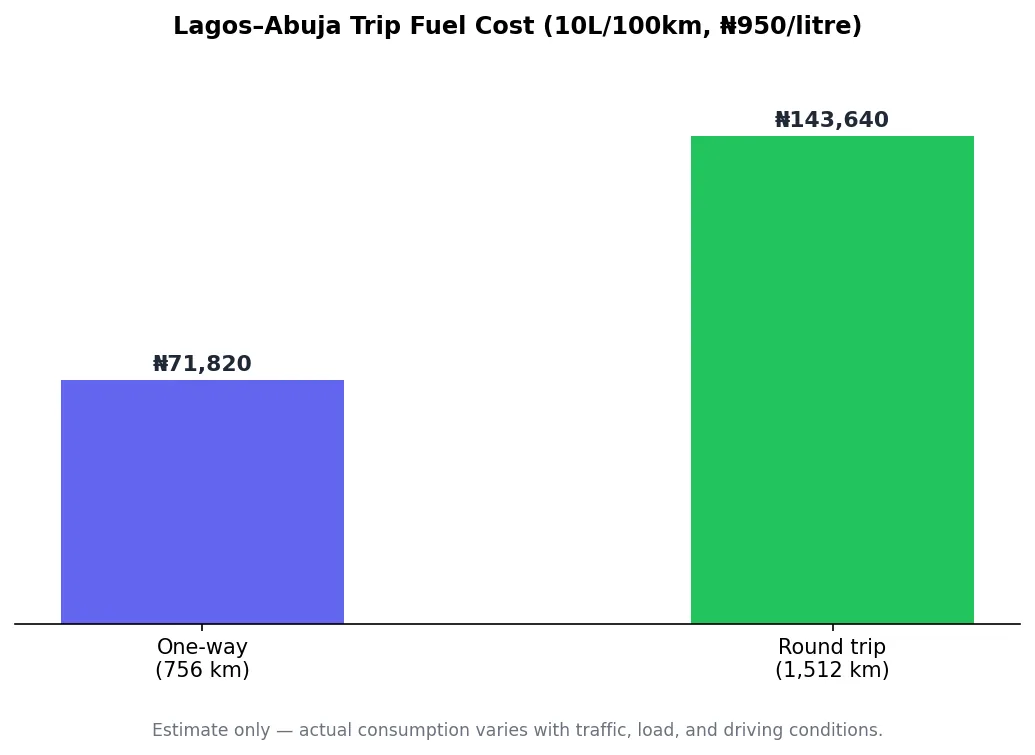
A Lagos to Abuja trip, one way, ~756 km, in a car averaging 10 litres/100km, fuel at ₦950/litre.
- Litres needed: (756 ÷ 100) × 10 = 75.6 litres
- Cost: 75.6 × ₦950 = ≈ ₦71,820
If a significant portion of the route involves heavy city traffic (e.g. navigating out of Lagos), applying the 25% city-driving adjustment to that portion would push the total higher — and a round trip simply doubles the one-way figure.
Things to know
- Fuel prices vary by state, depot, and station since the 2023 subsidy removal — always adjust the calculator's default to match your local pump price rather than relying on the built-in estimate.
- The tool supports petrol (PMS) and diesel (AGO), each with separate default prices — CNG isn't currently supported since it's priced per kilogram rather than per litre.
- Real-world consumption can exceed the formula estimate due to tyre pressure, vehicle condition, driving style, and AC use — treat the calculated figure as a planning baseline, not an exact prediction.
Fuel is often the single largest variable cost in any Nigerian road trip, and since the removal of the petrol subsidy in May 2023 that cost has become far harder to predict. A trip that cost fifteen thousand naira in fuel two years ago can now cost double or more, and the price at the pump can differ significantly depending on which state, filling station, or depot a driver buys from. This trip fuel cost calculator gives Nigerian drivers a fast, transparent way to estimate how much a journey will cost in fuel before they set out, whether that journey is a daily commute across Lagos, a weekend run from Lagos to Ibadan, or a long-distance trip from Lagos to Abuja.
The calculator works from three simple inputs: the distance of the trip in kilometres, the fuel efficiency of the vehicle in litres per 100 kilometres, and the current pump price per litre. From these it applies the standard fuel-consumption formula used by logistics planners and vehicle manufacturers worldwide: fuel needed in litres equals distance divided by 100, multiplied by the vehicle efficiency figure. That litre figure is then multiplied by the price per litre to produce a total cost, and divided by distance again to produce a cost-per-kilometre figure that is useful for comparing routes or vehicles. A driver covering the roughly 756-kilometre Lagos to Abuja corridor in a mid-size sedan averaging 10 litres per 100 kilometres would need about 75.6 litres of petrol, and at a pump price of 1,150 naira per litre that comes to a little over 86,000 naira one way.
Two adjustments make the estimate more realistic for Nigerian road conditions. The first is a city-versus-highway toggle. Stop-start traffic in Lagos, Abuja, Port Harcourt and other major cities can raise fuel consumption by twenty to thirty percent compared with steady highway driving, so the calculator applies a twenty-five percent uplift when city mode is selected. The second is a load adjustment for vehicles carrying a full complement of passengers or heavy cargo, which typically adds ten to fifteen percent to consumption. Drivers planning a round trip can tick a single box to double the distance rather than re-entering figures, and those who want a safety margin for detours, traffic diversions or fuel-station queues can add an eight percent contingency buffer to the total.
Fuel pricing in Nigeria is regulated under the framework established by the Petroleum Industry Act 2021, with the Nigerian Midstream and Downstream Petroleum Regulatory Authority, commonly known as the NMDPRA, responsible for overseeing the pricing, distribution and quality of petroleum products in the downstream market. Since the subsidy on premium motor spirit, commonly called petrol or PMS, was withdrawn in mid-2023, pump prices have moved with international crude prices, the naira exchange rate, and local logistics costs, rather than being fixed by government. The National Bureau of Statistics, or NBS, publishes periodic average pump price data by state, and it consistently shows that prices in Lagos and Ogun states, close to the major refineries and import terminals, tend to run lower than prices in northern states such as Borno, Sokoto or Taraba, where transport costs to inland depots push the retail price up. Because of this spread, this calculator treats the price per litre as a field the user sets themselves, with a periodically updated default shown alongside a last-updated date, rather than pretending to offer one authoritative national price.
Diesel, known locally as AGO, is priced separately from petrol and is used mainly by trucks, buses, generators and some SUVs. It typically trades at a premium to petrol and has historically been more volatile, since it is imported in different volumes and used heavily by industrial and haulage operators whose demand shifts with the wider economy. This calculator lets drivers switch between petrol and diesel defaults so that operators of diesel vehicles get a realistic starting price rather than a petrol figure that would understate their actual cost.
It is worth being clear about what this tool does not do. It is a budgeting estimate, not an official quotation from NNPC Retail, Dangote Petroleum Refinery, or any independent marketer, and it does not account for tolls, vehicle maintenance, driver fatigue stops, or the fuel a vehicle burns idling in traffic beyond the city-mode adjustment. Actual consumption also depends heavily on tyre pressure, engine condition, air-conditioning use, and how a vehicle is driven, so two identical cars on the same route can post noticeably different real-world figures. Nigerian vehicle emissions and fuel-quality standards, including specifications set by the Standards Organisation of Nigeria and ECOWAS fuel-quality harmonisation efforts, do not affect the arithmetic here but are part of the wider regulatory picture that shapes what fuel is available at the pump.
Drivers switching to compressed natural gas under initiatives such as the federal government's Presidential CNG Initiative will find their running costs behave differently again, since CNG is priced and measured separately from petrol and diesel and is not covered by this calculator's current defaults, though the same distance and efficiency logic would apply if a CNG price per kilogram were substituted for the petrol price.
For anyone planning a business trip, an inter-state haulage run, or simply trying to work out whether it is cheaper to drive or take a bus between two Nigerian cities, this fuel cost calculator turns a rough guess into a defensible number in seconds, using inputs the driver controls and can update as pump prices change.