Electricity Bill & Units Calculator Nigeria 2026 (NERC Band A–E Rates)
Estimate your Nigerian electricity bill or convert Naira to prepaid units using current NERC Band A–E tariffs, VAT-inclusive.
20+ hours of supply per day (cost-reflective, highest rate)
Typical households use 5–20 kWh/day.
Estimated units
41.34 kWh
Gross estimate (no VAT split): 44.44 kWh
Energy value after backing out 7.5% VAT: ₦9,302.33
Should last about 4.1 day(s) at your stated daily usage.
DisCo tariff table (₦/kWh, before VAT)
| DisCo | Band A | Band B | Band C | Band D | Band E |
|---|---|---|---|---|---|
| Abuja Electricity (AEDC) | 225.00 | 66.00 | 50.00 | 50.00 | 48.00 |
| Benin Electricity (BEDC) | 225.00 | 66.00 | 50.00 | 50.00 | 48.00 |
| Eko Electricity (EKEDC) | 209.50 | 66.00 | 50.00 | 50.00 | 48.00 |
| Enugu Electricity (EEDC) | 225.00 | 66.00 | 50.00 | 50.00 | 48.00 |
| Ibadan Electricity (IBEDC) | 225.00 | 66.00 | 50.00 | 50.00 | 48.00 |
| Ikeja Electric (IKEDC) | 206.80 | 66.00 | 50.00 | 50.00 | 48.00 |
| Jos Electricity (JED) | 225.00 | 66.00 | 50.00 | 50.00 | 48.00 |
| Kaduna Electricity (KAEDCO) | 225.00 | 66.00 | 50.00 | 50.00 | 48.00 |
| Kano Electricity (KEDCO) | 225.00 | 66.00 | 50.00 | 50.00 | 48.00 |
| Port Harcourt Electricity (PHED) | 225.00 | 66.00 | 50.00 | 50.00 | 48.00 |
| Yola Electricity (YEDC) | 225.00 | 66.00 | 50.00 | 50.00 | 48.00 |
| Aba Power (APLE) | 209.50 | 66.00 | 50.00 | 50.00 | 48.00 |
Rates shown are indicative, based on publicly reported NERC Multi-Year Tariff Order (MYTO) / Service-Based Tariff (SBT) figures last checked June 2026. Tariffs are reviewed periodically and can change without notice, and some DisCos apply small Band A variations. Confirm the exact rate on your own bill, meter receipt, or DisCo portal before making financial decisions — this tool does not connect to any live billing system and cannot reflect debt recovery, arrears, or estate/community-meter adjustments.
Electricity Bill & Units Calculator: Understanding NERC Bands, Tariffs and How Your Bill Is Worked Out
Last updated: August 2026·Reviewed by Chidinma Okafor, Tax Analyst in Lagos·Source
Nigeria's electricity billing isn't one national rate — NERC's Band system means your feeder's average supply hours determine which tariff you pay, and Band A customers can pay 3-4x more per unit than Bands B-E.
How it's calculated
Bill amount = units (kWh) × your DisCo's rate for your band, plus 7.5% VAT. For prepaid tokens, the naira amount is worked backward: VAT is removed first, then the remainder is divided by the per-unit rate to get units purchased.
| Band | Supply hours (feeder average) | Typical rate range |
|---|---|---|
| Band A | 20+ hours/day | ~₦206–₦225/kWh (cost-reflective) |
| Bands B–E | Under 20 hours/day (declining) | ~₦48–₦66/kWh (subsidized) |
Worked example
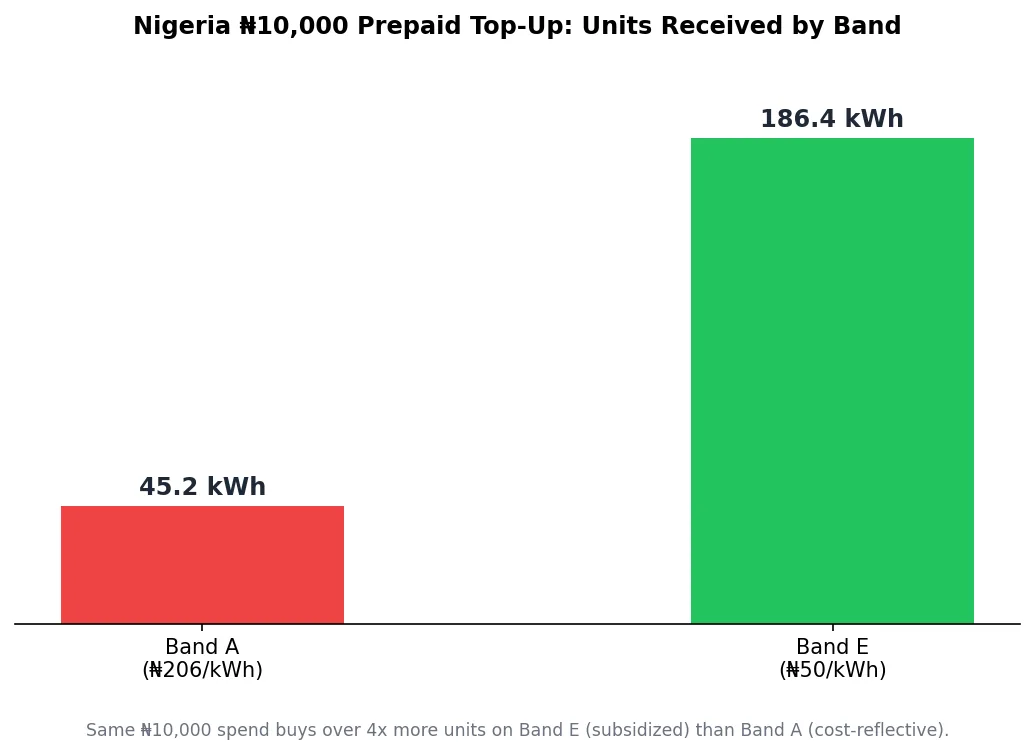
A Band A customer buys ₦10,000 of prepaid electricity, rate ₦206/kWh.
- Remove VAT (7.5%): ₦10,000 ÷ 1.075 = ₦9,302.33 net
- Units purchased: ₦9,302.33 ÷ ₦206 = ≈ 45.2 kWh
A Band E customer with the same ₦10,000 at ₦50/kWh would receive roughly 186.4 units — over 4x more units for the same naira spend, reflecting the subsidy gap between bands.
Things to know
- Your band is determined by your distribution company measuring average supply hours to your entire feeder, not your individual meter — everyone on that feeder shares the same band classification.
- Individual DisCos can set their Band A rate slightly below NERC's national ceiling — Ikeja Electric and Eko Electricity have both done this at various points, so exact rates differ by distributor.
- If a ₦5,000 top-up buys noticeably fewer units than before with no rate or band change, check your vending receipt for a fixed/service charge deduction or outstanding debt recovery — both come off before units are calculated.
Every household and business connected to the national grid in Nigeria pays for electricity under a framework set by the Nigerian Electricity Regulatory Commission, commonly known by its acronym NERC. Since April 2024, that framework has operated as the Service-Based Tariff, or SBT, a system that ties the price a customer pays per kilowatt-hour directly to the number of hours of electricity supply their feeder actually delivers. This calculator exists to take the guesswork out of that system, letting you either work out what a given amount of energy consumption will cost, or flip the question around and see how many units a fixed amount of money in Naira will buy you at the vending point.
The Service-Based Tariff sorts every connected customer into one of five bands, labelled A through E, based on the average number of hours of supply their local feeder receives, measured by the distribution company, or DisCo, over a reporting period. Band A customers receive a guaranteed minimum of twenty hours of electricity a day and pay the highest, most cost-reflective rate, currently in the region of two hundred and nine to two hundred and twenty-five Naira per kilowatt-hour depending on the DisCo, since a handful of distributors such as Ikeja Electric and Eko Electricity Distribution Company have applied downward adjustments to their own Band A feeders relative to the ceiling NERC approved. Band B customers get sixteen to twenty hours of supply, Band C between twelve and sixteen hours, Band D between eight and twelve hours, and Band E fewer than eight hours a day. Bands B through E remain heavily subsidised by the federal government and have stayed close to fifty to seventy Naira per kilowatt-hour for an extended period, since the policy intent behind the SBT was to protect lower-reliability, largely residential customers from the full cost-reflective price while asking better-served, higher-consuming Band A customers to shoulder a price that reflects the true cost of generating and distributing the power they use.
Working out a bill from a known number of units consumed is straightforward in principle. You multiply the number of kilowatt-hours used by the rate that applies to your band and your DisCo, which gives you the energy charge. Many postpaid and estate-metered customers also have a fixed or service charge added on top, covering costs unrelated to actual consumption, though the exact figure varies by customer class and DisCo, and this calculator lets you toggle a typical residential estimate on or off since not every account carries one. Once the energy charge and any fixed charge are added together to produce a subtotal, Value Added Tax at the statutory rate of seven and a half percent, as set out under the VAT Act as amended by the Finance Act, is applied on top to arrive at the final amount payable. This is the same VAT rate applied across most goods and services in Nigeria, and electricity is not exempt from it.
The more common question for prepaid customers, who make up the overwhelming majority of metered electricity users in the country, runs in the opposite direction: given that you are about to buy ten thousand Naira of credit, how many units will actually land on your meter? Vending platforms typically quote a price that already has VAT folded in, so this calculator backs the seven and a half percent tax out of your amount first to get the underlying energy value, then divides that by your band's per-kilowatt-hour rate to give an effective unit count. We also show a simpler gross estimate that skips the VAT adjustment, since some DisCo vending apps present figures slightly differently, and it is useful to see both so you are not caught off guard by a difference between what an app estimates and what actually appears on your meter after a top-up.
It's worth being clear-eyed about the limits of any calculator like this one. Tariffs are reviewed periodically by NERC, sometimes in response to shifts in gas prices, inflation, or the Naira-to-Dollar exchange rate, since a meaningful share of Nigeria's generation cost is dollar-denominated. A distribution company can also apply a small downward variation to its own Band A rate relative to the NERC ceiling, as both Ikeja Electric and Eko Electricity have done in the past. None of that shows up automatically here, and this tool has no live connection to any DisCo billing system, so it cannot account for arrears, debt recovery charges, estate or community meter allocations, or a band reclassification that hasn't yet been reflected in public reporting. Before making a financial decision based on any number this calculator produces, check your own most recent bill, meter receipt, or your DisCo's official portal or customer care line, and use your account or meter number to confirm exactly which band your feeder currently sits in. Bands are assigned at the feeder level, not the individual meter, which is why two houses on the same street can occasionally sit in different bands depending on which transformer and feeder actually serves them.