Nigeria Company Income Tax (CIT) Calculator 2026
Find out if your company qualifies as tax-exempt under the Nigeria Tax Act 2025, or calculate your 30% CIT plus 4% Development Levy in seconds.
Enter turnover, fixed assets, and profit to calculate
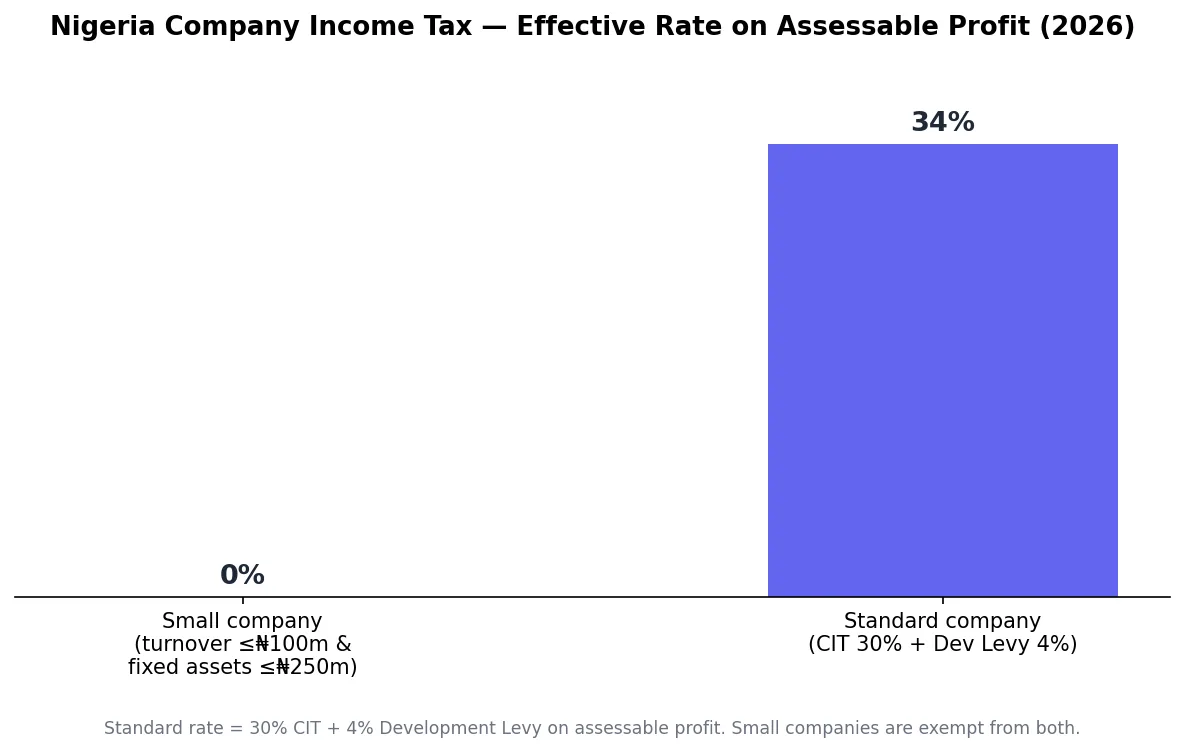
Under the Nigeria Tax Act 2025 (effective 1 January 2026), a "small company" is one with annual turnover of ₦100,000,000 or less AND total fixed assets of ₦250,000,000 or less — fully exempt from CIT, CGT, and the Development Levy. All other companies pay a flat 30% CIT plus a 4% Development Levy on assessable profit. This calculator is for guidance only and doesn't constitute tax advice — consult a licensed accountant for your specific filing.
Company Income Tax in Nigeria Under the 2026 Tax Reform: What Changed and Who Is Exempt
Last updated: August 2026·Reviewed by Chidinma Okafor, Tax Analyst in Lagos·Source
Company Income Tax (CIT) is the tax a registered company pays on its profit, not its turnover. Since 1 January 2026, whether you pay it at all — and how much — depends on the Nigeria Tax Act 2025's small-company test.
How it's calculated
A company is "small" — and fully exempt from CIT and the Development Levy — if it meets both conditions: annual gross turnover of ₦100,000,000 or less, and total fixed assets of ₦250,000,000 or less. If either threshold is crossed, the standard rates apply to assessable profit (not turnover).
| Company size | CIT | Development Levy | Total |
|---|---|---|---|
| Small (turnover ≤₦100m and fixed assets ≤₦250m) | 0% | 0% | 0% |
| Standard (medium/large) | 30% | 4% | 34% of assessable profit |
| Very large multinational groups | 15% minimum effective rate (global minimum tax rules) | — | — |
Worked example
Adaeze Foods Ltd has annual turnover of ₦180,000,000 (above the ₦100m threshold, so not a small company) and assessable profit of ₦25,000,000 for the year.
- CIT (30% of profit): ₦7,500,000
- Development Levy (4% of profit): ₦1,000,000
- Total tax due: ₦8,500,000
By contrast, Bola's Bakery, with turnover of ₦60,000,000 and fixed assets of ₦40,000,000, meets both small-company conditions and owes ₦0 in CIT and Development Levy — though it must still file its annual returns.
Things to know
- The Development Levy replaced four separate levies (Tertiary Education Tax, IT Levy, NASENI Levy, Police Trust Fund Levy) that used to be calculated individually.
- Being exempt from CIT does not remove the obligation to file annual returns — missing the deadline can attract penalties even when no tax is owed.
- Fixed assets are valued at book/carrying value, not market value — check with an accountant if your balance sheet classification is unclear.
Company Income Tax has always been one of the more confusing parts of running a business in Nigeria, and the reforms that took effect on 1 January 2026 changed both the numbers and the definitions companies need to know. The Nigeria Tax Act (NTA) 2025, one of four tax reform bills signed into law by President Bola Ahmed Tinubu on 26 June 2025, rewrote the rules on which companies pay CIT at all, and introduced a new levy that replaces four older ones companies used to track separately.
The single biggest change is the small company exemption threshold. Under the old regime, a company qualified as "small" and paid a reduced CIT rate if its annual turnover was ₦25 million or less. The NTA raises that threshold to ₦100 million in annual gross turnover, and adds a second condition: total fixed assets must also not exceed ₦250 million. A company only needs to fail one of those two tests to lose small company status, so a business with low turnover but a large asset base, such as heavy machinery or property, would not qualify even if its revenue looks modest. If a company meets both conditions, it is not just taxed at a lower rate anymore, it is fully exempt from Company Income Tax, Capital Gains Tax, and the new Development Levy altogether. That is a meaningful shift from a reduced rate to a genuine exemption, and it is designed to pull more informal and micro businesses into the formal tax net by making formal registration less costly rather than more.
Companies that do not qualify as small pay CIT at a flat 30%, unchanged from the previous law, applied to assessable profit after allowable deductions. On top of that, the NTA introduces the Development Levy, a new 4% charge on assessable profits that consolidates four separate levies companies previously had to calculate and remit individually: the Tertiary Education Tax (TET), which was 3% under the old law, the Information Technology Levy, the NASENI Levy, and the Police Trust Fund Levy. Rolling four levies into one 4% charge is meant to simplify compliance, even though for a typical large company the combined rate is broadly similar to what the old separate levies added up to. Small companies, as defined above, are exempt from the Development Levy as well as from CIT.
It's worth being precise about a separate ₦50 million figure that often gets confused with the ₦100 million small company threshold: that lower number is the VAT registration threshold, the point at which a business must register for and start charging Value Added Tax. These are two different tests for two different taxes. A company can be below the ₦50 million VAT threshold and not need to charge VAT, while separately needing to check its turnover and fixed assets against the ₦100 million and ₦250 million CIT exemption tests. Getting the two mixed up is one of the most common mistakes business owners make when trying to self-assess their obligations under the new law.
There is also a third, more specialised rule that most ordinary Nigerian companies will never encounter: a 15% minimum effective tax rate that applies only to very large multinational enterprise groups above internationally defined revenue thresholds, broadly aligned with the OECD's global minimum tax framework. This calculator is built for standard Nigerian companies working out their small company status and ordinary CIT liability, not for multinational groups assessing that separate minimum tax regime, which requires specialist international tax advice.
Even companies that qualify as fully exempt still have compliance obligations. Small companies must continue to file annual returns with the Nigeria Revenue Service (NRS), the agency that replaced the Federal Inland Revenue Service (FIRS) under the accompanying Nigeria Revenue Service Act 2025. Exemption from paying CIT is not the same as exemption from filing, and failing to file on time can attract penalties regardless of how much tax is actually owed.
This calculator takes your annual turnover, total fixed assets, and assessable profit, checks whether your company meets both small company conditions, and if not, calculates your 30% CIT plus 4% Development Levy in one step. It is meant to give you a fast, informed estimate before you sit down with your accountant, not to replace the professional judgement needed for an actual tax filing, which can involve deductions, reliefs, and edge cases this simple calculator does not attempt to model.