NELFUND Student Loan Repayment Calculator Nigeria | Estimate Your Monthly Deduction
Project your NELFUND student loan repayment schedule based on the 2-year grace period, 0% interest, and 10% income deduction rule.
For estimation only. Assumes 0% interest, a 2-year post-NYSC grace period, and a flat 10% deduction of income as set out in the Student Loans (Access to Higher Education) Act and NELFUND guidelines. Actual repayment terms are determined by the NELFUND portal and applicable law — consult official sources before making financial decisions. USD figures are indicative only, converted at the exchange rate available at page load.
NELFUND Student Loan Repayment Calculator: Plan Your 10% Deduction and Payoff Timeline
Last updated: August 2026·Reviewed by Chidinma Okafor, Tax Analyst in Lagos·Source
NELFUND's student loan is structurally different from a typical bank loan — it charges zero interest, and repayment doesn't start on a fixed date but is tied to your employment status after NYSC.
How it's calculated
There's no interest, so you only ever repay exactly what was disbursed. Repayment is income-contingent: once it starts, 10% of your monthly salary (if employed) or monthly profit (if self-employed) is deducted, continuing until the balance reaches zero — however long that takes.
| Stage | What happens |
|---|---|
| During studies + NYSC | No repayment; loan accrues no interest |
| 2 years after NYSC completion | Repayment begins |
| Employed | Employer deducts 10% of monthly salary at source, like PAYE |
| Self-employed | Beneficiary remits 10% of monthly profit directly |
| Unemployed after grace period | No repayment due, if a 3-monthly unemployment affidavit is filed |
Worked example
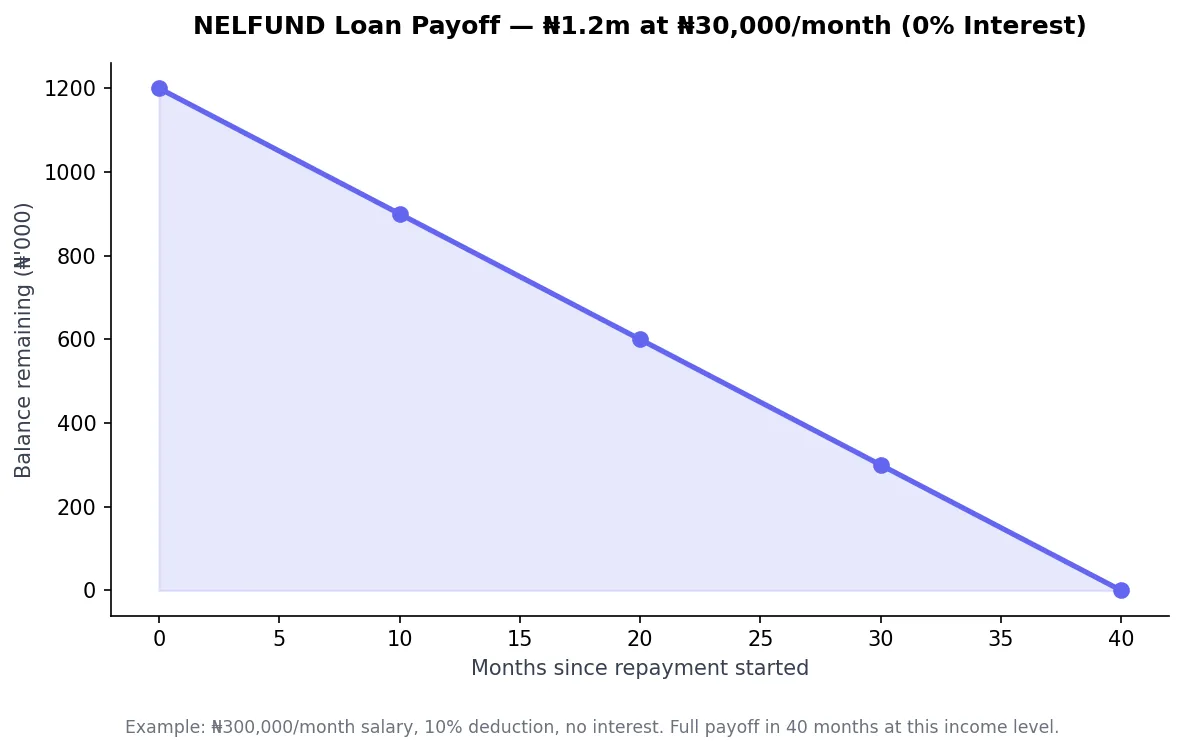
A NELFUND beneficiary owes ₦1,200,000 and starts a job earning ₦300,000/month, two years after NYSC.
- Monthly deduction: 10% of ₦300,000 = ₦30,000
- At that rate (assuming stable income, no interest), full repayment takes: ₦1,200,000 ÷ ₦30,000 = 40 months (≈ 3.3 years)
If income rises, the naira amount deducted rises with it (still 10%), which shortens the payoff time. Voluntary extra payments at any point also shorten it directly, since there's no interest to offset.
Things to know
- The loan is written off entirely if the beneficiary dies or becomes permanently disabled — the debt does not transfer to family or an estate.
- Repayment is income-contingent, not fixed-term — there's no set number of years; it continues until the balance is cleared.
- Filing the required 3-monthly unemployment affidavit is what pauses deductions during genuine unemployment — missing that filing can trigger repayment expectations even without income.
Nigeria's Student Loans (Access to Higher Education) Act, signed into law in 2024, established the Nigerian Education Loan Fund, commonly known as NELFUND, as the body responsible for financing tuition and upkeep for students in Nigerian tertiary institutions. For the growing number of graduates and current beneficiaries trying to plan their finances, understanding exactly how and when repayment begins is often more confusing than the loan application itself. This calculator was built to translate the official NELFUND repayment framework into a simple, interactive projection so beneficiaries can see, in naira and in months, what their obligation actually looks like.
Unlike a conventional bank loan, the NELFUND facility charges 0% interest. Whatever amount was disbursed for tuition and upkeep is exactly what is owed, with nothing added over time. This single feature separates it from commercial student financing products elsewhere in the world and is the reason this tool never shows an interest line item beyond zero. There is no compounding, no penalty interest, and no hidden charges baked into the balance. The only variable that moves the numbers is time and the beneficiary's own income.
Repayment does not start immediately after graduation. NELFUND guidelines, aligned with the enabling Act, build in a two-year grace period measured from the completion of the National Youth Service Corps, or from an approved exemption for beneficiaries who are not required to serve. During both the period of study and the full NYSC year, no deductions occur at all. It is only once that two-year window closes that the repayment mechanism activates. This calculator lets a user enter their actual or expected NYSC completion date and automatically projects the exact month repayment is due to begin, rather than leaving that arithmetic to guesswork.
Once repayment starts, the mechanism itself depends on employment status. A beneficiary who takes up formal employment has their obligation collected at source: the employer is expected to deduct 10 percent of the employee's monthly salary and remit it toward the outstanding balance, similar in spirit to how PAYE tax is withheld before wages reach a worker's account. A beneficiary who is self-employed, running a business or offering services independently, is instead expected to remit 10 percent of monthly profit directly. The calculator reflects both paths by letting the user toggle between "Employed Salary" and "Self-Employed Monthly Profit" before running the 10 percent deduction against whichever figure applies.
Beneficiaries are also permitted to pay more than the mandated 10 percent at any point, whether through a lump sum or a higher recurring amount, without penalty. Because there is no interest accruing, every extra naira paid shortens the timeline by exactly that amount rather than being partially absorbed into interest charges the way an interest-bearing loan would behave. This tool includes an optional extra monthly payment field precisely so a beneficiary who wants to clear the balance faster, perhaps before a major life event or simply for peace of mind, can see the realistic effect of doing so.
Not every beneficiary walks straight into steady income after NYSC. The framework explicitly anticipates periods of unemployment and does not penalize beneficiaries for it. Someone who remains unemployed after the grace period ends is not required to make deductions, provided they submit an affidavit confirming their unemployment status every three months to the relevant authority. This calculator includes a "Delayed (unemployed scenario)" mode that pushes the effective repayment start further out, mirroring what a real affidavit-based deferment would look like, and labels the corresponding months in the schedule as requiring an affidavit rather than a payment.
Two further protections are worth understanding even though they sit outside a repayment calculator's core arithmetic. The loan is written off entirely in the event of the beneficiary's death or permanent disability, so no debt passes to a beneficiary's estate or family. And because repayment is income-contingent rather than fixed-term, there is technically no maximum repayment period specified beyond the 10 percent mechanism running until the balance reaches zero, which is why this tool caps its own projection at a reasonable horizon for display purposes while still calculating the true payoff point underneath.
On the amounts themselves, NELFUND covers both institutional fees paid directly to the school and a personal upkeep component paid to the student, which in various disbursement cycles has been capped in the region of twenty thousand naira per month. This calculator treats the combined tuition-plus-upkeep figure as a single principal, but a user who wants to see the two pieces separately can simply run the calculator twice with each component entered individually.
Finally, because many beneficiaries think in both naira and, informally, in dollar terms when comparing costs, this tool includes an optional USD display. It fetches an indicative exchange rate from a free public API when the page loads. If that source is temporarily unavailable, the calculator falls back to displaying naira only and flags that the USD conversion could not be retrieved, rather than showing a stale or estimated figure that could mislead a user.
This tool is for estimation only. It is not legal or financial advice, and it does not replace guidance from the official NELFUND portal, your institution's financial aid office, or a qualified financial adviser. Loan terms, deduction rules, and grace period policy can be updated by NELFUND or by subsequent legislation, and any such update should always take precedence over the assumptions built into this calculator.