School Fees True Cost Calculator Nigeria - Total Annual Cost Estimator
Calculate the real annual cost of school fees in Nigeria, including tuition plus hidden extras like uniforms, levies, and transport.
School details
Additional / hidden fees
Figures are indicative planning estimates based on typical published fee ranges for Nigerian schools and are not live data from any specific institution. Actual costs vary by school, session, and location — always confirm with the school's official fee schedule before budgeting. This tool provides general information only and is not financial, legal, or tax advice.
School Fees True Cost Calculator for Nigeria: What You Will Really Pay
Last updated: August 2026·Reviewed by Chidinma Okafor, Tax Analyst in Lagos·Source
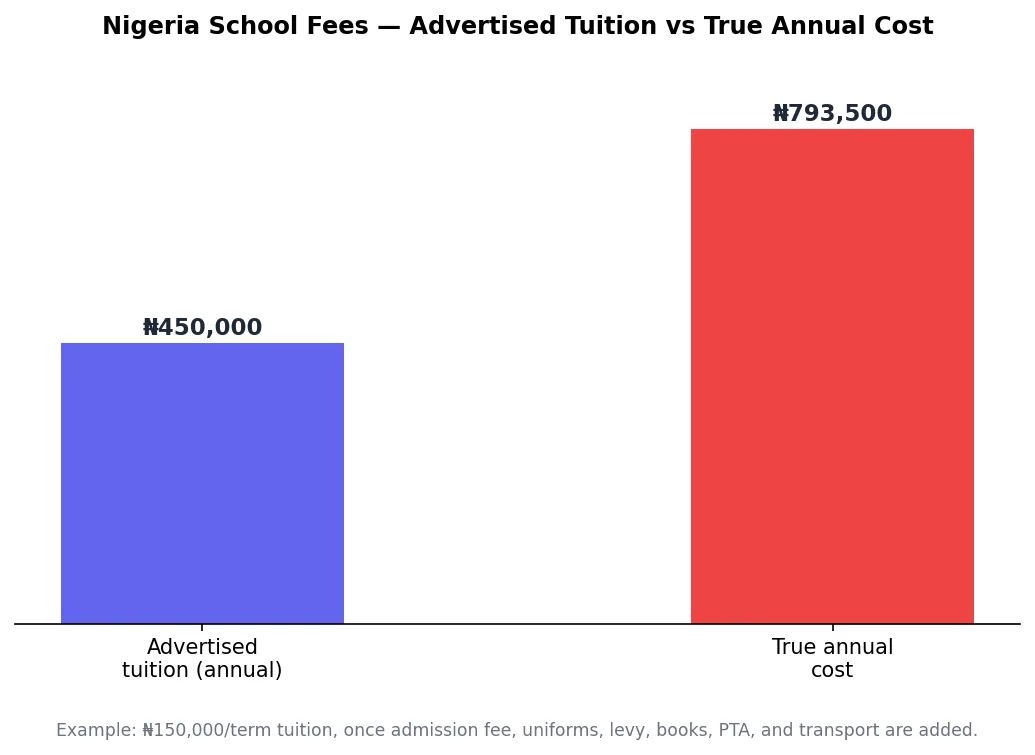
The tuition figure on a school's fee schedule is rarely the whole cost — development levies, uniforms, books, PTA fees, transport, and a first-term admission charge typically add 30-60% on top.
How it's calculated
True annual cost = tuition (all terms) + development levy + uniforms + books + PTA/exam fees + transport + a one-time first-term admission charge, plus a 10-20% buffer for mid-year extras.
| Cost component | When it applies |
|---|---|
| Tuition | Every term |
| First-term admission/registration fee | Once, first term only |
| Uniforms | Mostly first term, occasional replacements |
| Development levy | Often annual |
| Transport, books, PTA/exam fees | Ongoing, varies by term |
Worked example
A private secondary school quotes ₦150,000/term tuition.
- Annual tuition (3 terms): ₦450,000
- First-term admission fee: ₦50,000 (one-time)
- Uniforms: ₦40,000 (mostly one-time)
- Development levy (annual): ₦30,000
- Books, PTA, transport (annual estimate): ₦120,000
- Subtotal: ₦690,000
- With a 15% buffer for mid-year extras: ≈ ₦793,500 true annual cost
That's 76% above the advertised ₦450,000/year tuition figure alone.
Things to know
- Public basic education (early childhood through junior secondary) is intended to be free and compulsory under the Universal Basic Education Act 2004, but development levies and other charges are still commonly collected in practice.
- Core tuition is generally VAT-exempt, but ancillary items (branded uniforms, transport, some extracurricular packages) can attract the standard 7.5% VAT rate depending on how they're invoiced.
- Boarding adds a substantial per-term surcharge on top of tuition for accommodation and feeding — budget this separately from day-student costs.
Most Nigerian parents budgeting for a new school year start with one number: the tuition figure printed on the school's fee schedule. In practice, that number rarely represents what a household actually spends. Development levies, uniforms, textbooks, PTA dues, transport, feeding, ICT charges, excursions, and a first-term admission fee are usually billed separately, and together they can push the real annual cost 30 to 60 percent above the advertised tuition. The School Fees True Cost Calculator for Nigeria was built to close that gap: it takes the base tuition a school quotes and layers on the additional charges that typically follow, so a parent, guardian, or school administrator can see a realistic first-term cash requirement, a recurring per-term cost, and a full annual total before enrollment day arrives.
The calculator covers nursery and primary school, junior secondary (JSS), senior secondary (SSS), and basic tertiary institutions such as polytechnics and colleges of education. It separates public/government schools from low-cost, mid-range, high-end, and international private schools, because the composition of hidden costs differs sharply across these categories. A public primary school in a state capital may charge no tuition at all yet still collect a development levy, exam fees, and uniform costs from parents. A high-end private secondary school in Lagos or Abuja, by contrast, may bundle far more into a single termly invoice but still leave transport, excursions, and ICT charges as separate line items. The tool's location setting also reflects the reality that fees in Lagos and Abuja generally run higher than in other state capitals, and it lets a parent switch a child between day and boarding status, since boarding typically adds a substantial termly surcharge on top of tuition.
A key reason this calculator exists is legal and regulatory context that most fee estimates ignore. The Universal Basic Education Act 2004 establishes free, compulsory basic education for the first nine years of schooling — early childhood care through junior secondary — administered nationally through the Universal Basic Education Commission and, at state level, through each State Universal Basic Education Board (SUBEB). In principle, a public school within that bracket should not charge tuition. In practice, levies described as development, examination, or PTA fees are still common, and this calculator treats those as a distinct, trackable category rather than folding them silently into "tuition," so a parent can see exactly what is being charged for something that is nominally free. For private schools, fee-setting is largely market-driven, but it is not entirely unregulated: several states require schools to notify or seek approval from the state Ministry of Education before raising fees, and Kano State in particular has taken a more active regulatory stance on fee hikes and on charges deemed arbitrary. Lagos State's Education Law likewise sets out registration and operating conditions for private schools, even though it does not cap tuition directly. None of this is offered as legal advice — the calculator is an informational budgeting tool, not a compliance instrument — but naming the relevant framework helps parents understand why "free" and "regulated" don't always mean the same thing in Nigerian schooling.
Value-added tax is the other regulatory thread worth naming explicitly. Under Nigeria's VAT framework, administered by the Federal Inland Revenue Service (FIRS), core educational services — tuition itself — are generally treated as VAT-exempt, but ancillary items purchased through or alongside the school, such as branded uniforms, transport services, and some extracurricular packages, can attract the standard 7.5 percent VAT rate depending on how they are supplied and invoiced. The calculator includes an optional toggle that applies 7.5 percent to the specific line items where VAT commonly shows up, so a parent can see both a VAT-exclusive and a VAT-inclusive total rather than being surprised by a rounded-up invoice.
Beyond the regulatory context, the calculator is built around a simple planning principle: a first term almost always costs more than the terms that follow, because admission or registration fees, a full uniform set, and sometimes a development levy all land at once. The tool separates that first-term spike from the steady-state per-term cost, then projects a full annual total across the number of terms a school runs — usually three — and multiplies across however many children a household is enrolling. It also proposes an emergency buffer, adjustable between roughly 10 and 20 percent, to absorb the mid-year add-ons that rarely appear on an initial fee schedule: an unplanned excursion, a lost textbook, a sudden transport increase.
Every default figure in the calculator is an editable estimate drawn from typical published ranges for each school category and location, not a live feed from any single institution, and the tool says so plainly. Parents are encouraged to request a complete, itemized invoice directly from the school and adjust every field accordingly — the calculator's real job is to make sure no category of cost gets forgotten, not to replace the school's own paperwork. Used that way, it turns an opaque, term-by-term guessing exercise into a single annual number a household can actually save toward, broken down into a monthly target, a first-term cash requirement, and a clear picture of how much of the total sits outside the advertised tuition line.