Poultry Farm Startup Cost & Break-Even Calculator Nigeria (2026)
Calculate your poultry farm startup cost in Nigeria, cost per bird, and how many birds or eggs you need to sell to break even.
Farm Basics
Costs
Revenue Assumptions
Your results
Cost per bird to slaughter
₦4,859
Total investment needed
₦2,186,552
Break-even
Sell 191 birds to break even
Cost breakdown
Cumulative cost vs. revenue
Sensitivity: what moves your cost per bird
| Scenario | Cost per bird (₦) |
|---|---|
| Base case | ₦4,859 |
| Mortality +2% | ₦4,904 |
| Mortality -2% | ₦4,816 |
| Feed price +20% | ₦5,435 |
| Feed price -20% | ₦4,283 |
Nigeria averages used
- Day-old broiler chicks: roughly ₦500–₦700 per chick from major hatcheries in 2026; point-of-lay pullets run considerably higher, often ₦1,300–₦1,600.
- 25kg bag of commercial feed: widely ranges ₦18,000–₦24,000 depending on brand, stage (starter/grower/finisher) and location — feed is typically the single largest cost driver.
- Mortality: commonly budgeted at 8–12% for broilers to slaughter and 5–8% for layers to point-of-lay, higher without good biosecurity.
- Live broiler selling price: approximately ₦10,000–₦15,000 per bird at 2026 market rates, though this swings with regional day-old chick supply.
Figures are planning estimates only, built from typical 2026 Nigerian market ranges for day-old chicks, feed and labour. Actual prices vary by state, hatchery and season — always confirm current prices with your supplier before committing capital. This tool does not provide financial, veterinary or legal advice.
For commercial operations in Nigeria, consider registering your business with the Corporate Affairs Commission (CAC). Source chicks from reputable hatcheries and follow guidance from a licensed veterinarian for vaccination and disease control.
Poultry Farm Startup Cost and Break-Even Calculator for Nigeria
Last updated: August 2026·Reviewed by Dr. Ifeoma Nwachukwu, Health Policy Analyst in Lagos·Source
Broilers and layers have fundamentally different cost-and-payback timelines — broilers turn capital over in weeks but earn once per bird, while layers tie up capital longer but then produce ongoing revenue for months.
How it's calculated
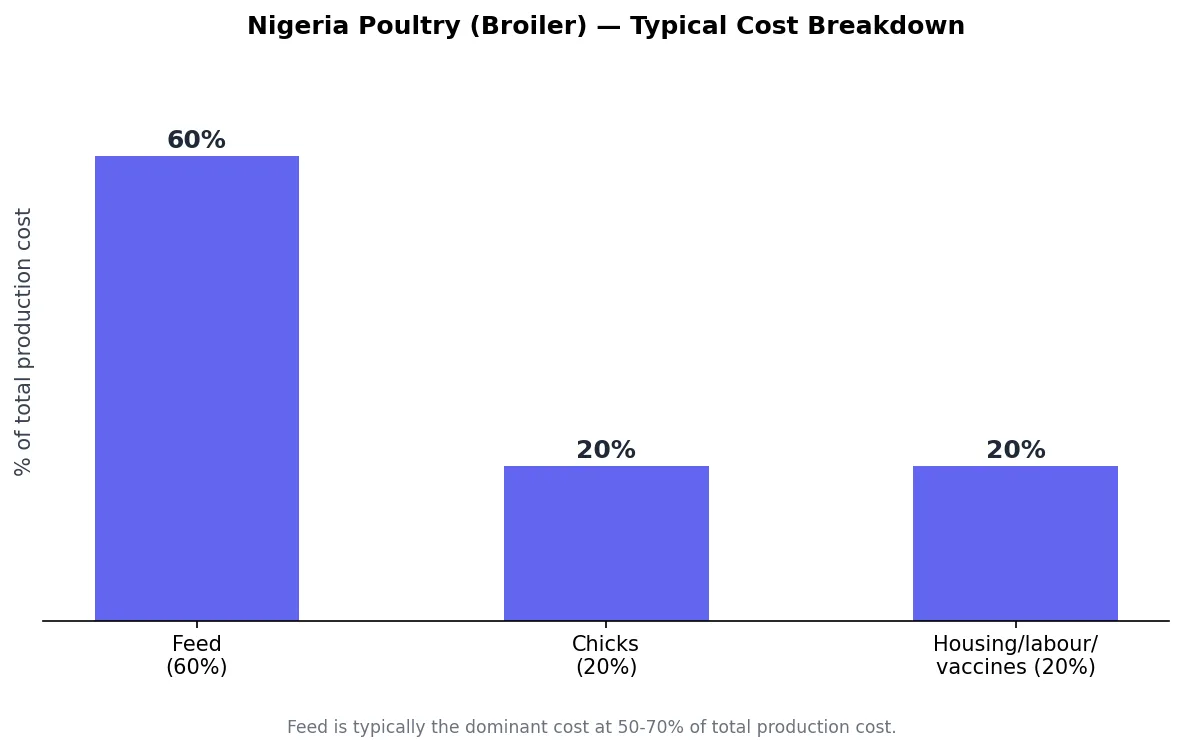
Break-even is total cost (chicks, feed, housing, labour, vaccines) divided by expected revenue per bird or per egg. Feed is typically the dominant cost — 50-70% of total production cost by the time a bird reaches market weight or point-of-lay.
| Broilers | Layers | |
|---|---|---|
| Time to revenue | 6–8 weeks (slaughter weight) | 18–20 weeks (point-of-lay) |
| Revenue pattern | One-time, per bird | Ongoing, per egg, for months |
| Typical mortality budget | 8–12% | 5–8% |
Worked example
500 broiler chicks at ₦550 each, targeting 6-week slaughter weight.
- Day-old chicks: 500 × ₦550 = ₦275,000
- Feed (estimate, 50-70% of total cost): roughly ₦700,000–₦900,000 for the full cycle
- Housing, labour, vaccines, other: roughly ₦150,000–₦250,000
- Total cost estimate: ₦1,125,000–₦1,425,000
- At 10% mortality, 450 birds reach market; break-even sale price per bird ≈ ₦2,500–₦3,167, depending on actual costs
Things to know
- Many first-time farmers start with 100-500 chicks to limit capital exposure while learning local mortality rates and cash flow patterns before scaling.
- CAC registration isn't required for a small backyard flock, but becomes important for a business bank account, supplier credit, or agricultural loan access.
- Feed prices fluctuate throughout the year with maize and soybean meal costs — running the numbers with your current local prices matters more than any generic industry figure.
Starting a poultry farm in Nigeria is one of the most common small business ventures in the country, and it is also one of the easiest to get financially wrong. New entrants typically fix on a single number, such as the price of day-old chicks, and build a mental budget around it, only to discover mid-cycle that feed, labour, housing and veterinary costs have quietly doubled the real capital required. This poultry farm startup cost and break-even calculator is built to close that gap by giving Nigerian poultry farmers, both first-time entrants and those scaling an existing operation, a realistic, editable model of what a broiler or layer flock actually costs from day-old chick to point-of-lay or slaughter, and exactly how many birds or eggs must be sold to recover that investment.
The calculator separates broiler and layer economics because the two models behave very differently. Broiler production runs on a short six-to-eight week cycle to market weight, which means capital turns over quickly but margins depend heavily on live bird prices at the point of sale. Layer production requires carrying pullets through an eighteen-to-twenty-week rearing period before they begin laying, which means a longer capital lock-up but a longer revenue stream afterward through daily egg sales. Choosing between the two is really a decision about how much capital you can tie up and for how long, and the calculator lets you toggle between them to see the difference in cost per bird and break-even timing side by side.
Feed is consistently the dominant cost in Nigerian poultry production, commonly representing fifty to seventy percent of total input cost by the time a bird reaches market weight or point-of-lay. This is why the calculator asks for both the price of a 25kg bag of feed and the total feed consumed per bird over the production period, rather than assuming a fixed number. Feed prices for starter, grower and finisher rations in Nigeria vary widely by brand, formulation and location, and they move with the price of maize and soybean meal, the two dominant feed ingredients. Because these prices shift throughout the year, every default in this tool is editable, and the assumptions panel beneath the results explains exactly what ranges were used so you can adjust them to match your local supplier's current quote before you commit money.
Day-old chick prices are the second major variable. Broiler day-old chicks from Nigeria's major hatcheries are typically sold in cartons rather than individually, and per-chick pricing has fluctuated considerably as hatchery supply tightened in 2026. Point-of-lay pullets and layer day-old chicks generally carry a meaningfully higher unit price than broiler chicks, reflecting the longer investment a hatchery makes in a bird destined to lay eggs rather than be slaughtered young. Mortality is the other major swing factor: a jump of even two percentage points in mortality rate can noticeably raise the effective cost per surviving bird, because fixed costs such as housing and labour are spread across fewer animals. The calculator's sensitivity table shows exactly how much your cost per bird moves if mortality rises or feed prices swing twenty percent in either direction, which is the kind of stress test that a fixed spreadsheet template rarely offers.
Beyond the maths, Nigerian poultry entrepreneurs operate inside a specific regulatory and institutional landscape that is worth understanding before scaling past a backyard operation. Registering a poultry business as a limited liability company or business name is done through the Corporate Affairs Commission, the federal agency established under the Companies and Allied Matters Act to administer company and business name registration in Nigeria. Formal registration matters for opening a dedicated business bank account, applying for agricultural loans, and qualifying for support schemes such as the Central Bank of Nigeria's Anchor Borrowers' Programme or state-level agricultural credit guarantee schemes. On the veterinary and input side, commercial poultry medications, vaccines and certain feed additives fall under the regulatory purview of the National Agency for Food and Drug Administration and Control, which registers and monitors veterinary drugs sold in Nigeria, while day-to-day flock health and vaccination scheduling is best handled through a licensed veterinarian or the Federal Ministry of Agriculture's extension services rather than guesswork. On tax, profits from many primary agricultural activities in Nigeria, including poultry farming, can benefit from exemptions or reduced rates under the Companies Income Tax Act and related agricultural incentive provisions administered by the Federal Inland Revenue Service, though the specific treatment depends on business structure and scale, so a qualified accountant should confirm your position rather than relying on general assumptions.
This tool is a financial planning aid, not legal, tax or veterinary advice, and it does not replace due diligence with your own suppliers, hatchery, veterinarian, or accountant. Its purpose is to give you a fast, editable, transparent view of what a broiler or layer flock in Nigeria is likely to cost, where the biggest risks to your budget sit, and how many birds or eggs you would need to sell to reach break-even, so that whatever number you eventually commit to paper reflects your actual local costs rather than a figure you overheard.